Sources of Information
Genealogical Archives for Springorum Hunting
Civil Registrations
The Netherlands
In the Netherlands, churches began keeping baptism, marriage, and burial records as early as the 16th century. These so-called DTB registers (Doop-, Trouw- en Begraafboeken) are often the oldest sources for family research and in some places go back to the 1500s. In addition to the standard entries, church books sometimes include other notes, such as information about church membership, confessions of faith, or remarriages, which can provide extra context about the lives of ancestors.
In 1811, during the French era, the civil registry (burgerlijke stand) was introduced. From then on, births, marriages, and deaths had to be registered with the municipality. Church books continued to exist, but no longer had any official legal status.
To this day, there are fixed terms before these records become public:
- Birth records: after 100 years
- Marriage records: after 75 years
- Death records: after 50 years
After this period, they are transferred to municipal or regional archives, where they are preserved permanently and can be consulted for historical and genealogical research.
Digitization in the Netherlands
Many DTB books and civil registry records have now been digitized and are searchable online via websites such as WieWasWie, OpenArchieven, and the websites of regional archives. Increasingly, archives make scans and transcriptions freely available, although the level of accessibility differs by municipality. Thanks to indexing projects carried out by volunteers, many names are already searchable, but the original scans remain the most important source.
Germany
In Germany, too, church books have been kept since the 16th century, carefully recording baptisms, marriages, and burials. As in the Netherlands, these sometimes contain additional information, such as details about moves, illegitimate births, attestations, or name variations. For family research prior to the civil registry, these records remain an indispensable source.
The first official civil registration took place in Prussia in 1874, where births, marriages, and deaths were from then on required to be recorded by the state. A year later, in 1875, this system was extended to the entire German Empire by a new imperial law. From that point on, church entries lost their legal validity, and only civil marriages were recognized by the state. This change was an important result of the so-called Kulturkampf between state and church.
Germany also has fixed terms before records become public:
- Birth records: after 110 years
- Marriage records: after 80 years
- Death records: after 30 years
After these terms expire, the registers are transferred to city or state archives, such as the Bochum City Archive. There they are preserved permanently as cultural heritage and can be consulted for research into family history and urban development.
Digitization in Germany
Digitization here is less uniform than in the Netherlands. Many church books are already available online via platforms such as Matricula-Online, Archion, and the websites of regional church archives. Unfortunately, they are often not indexed, which means you cannot search by name but must browse through them manually. For civil registry records, scans are often only accessible in the reading room or by request; only a few archives already offer digital access. The extent of digitization depends strongly on the federal state and the specific archive.
INFORMATION RESOURCES
OpenArchieven
Access to all Dutch archives
OpenArchieven is a Dutch‑Belgian genealogy portal that provides searchable access to millions of archival records—births, marriages, deaths, notarial acts, and more—from archives and historical societies across the Netherlands and Belgium. It offers robust search tools for people and surnames, automatic linking of related documents, downloadable results (e.g. GEDCOM, CSV, PDF), transcription snippets, and a subscription-based model (free trial, then €22/year for full access).
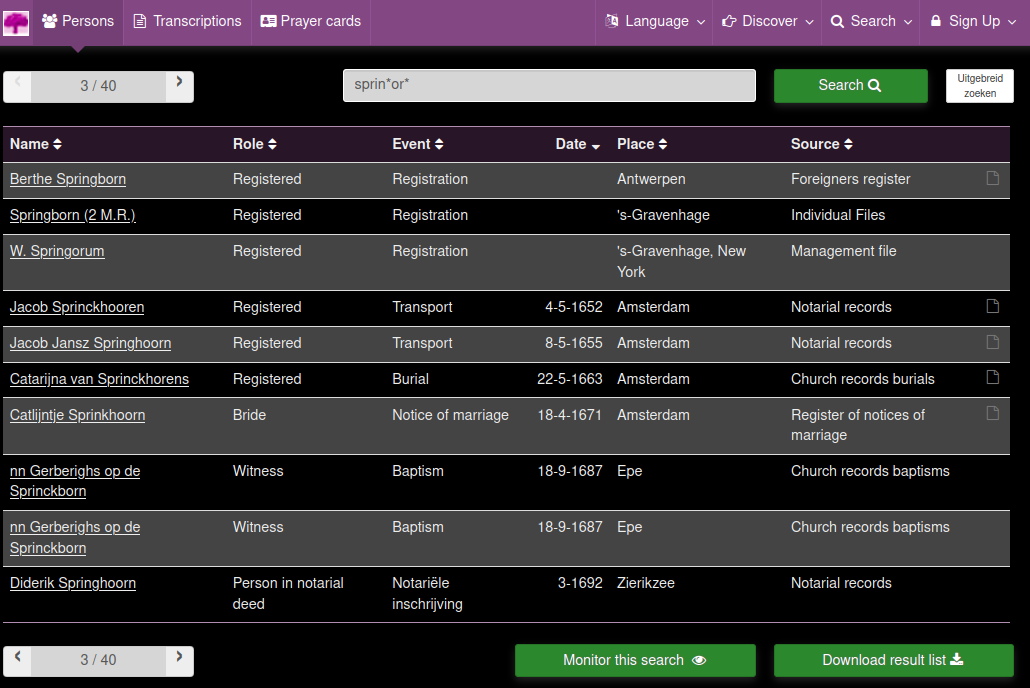 Openarchieven.nl is arguably the best starting point for researching Dutch archives. Search results link directly to the relevant municipal archives. The support of wildcards (Like: "sprin*or*" in the screen above) helps to find results with various spelling of the name Springorum.
Link: https://www.openarchieven.nl/
Stadsarchief Amsterdam
City archive of Amsterdam
The Amsterdam City Archives (Stadsarchief Amsterdam) is the municipal archive of Amsterdam, based in the historic De Bazel building. It preserves around 50 km of records—including municipal, church, business, and university collections—spanning nearly 750 years of the city's history. The archive offers an online image bank (over 260,000 items) and searchable indexes and inventories, with more than seven million digitized records freely available on its website. On-site visitors can access original documents, request scans on demand, attend exhibitions, and use research facilities in the Vijzelstraat location.
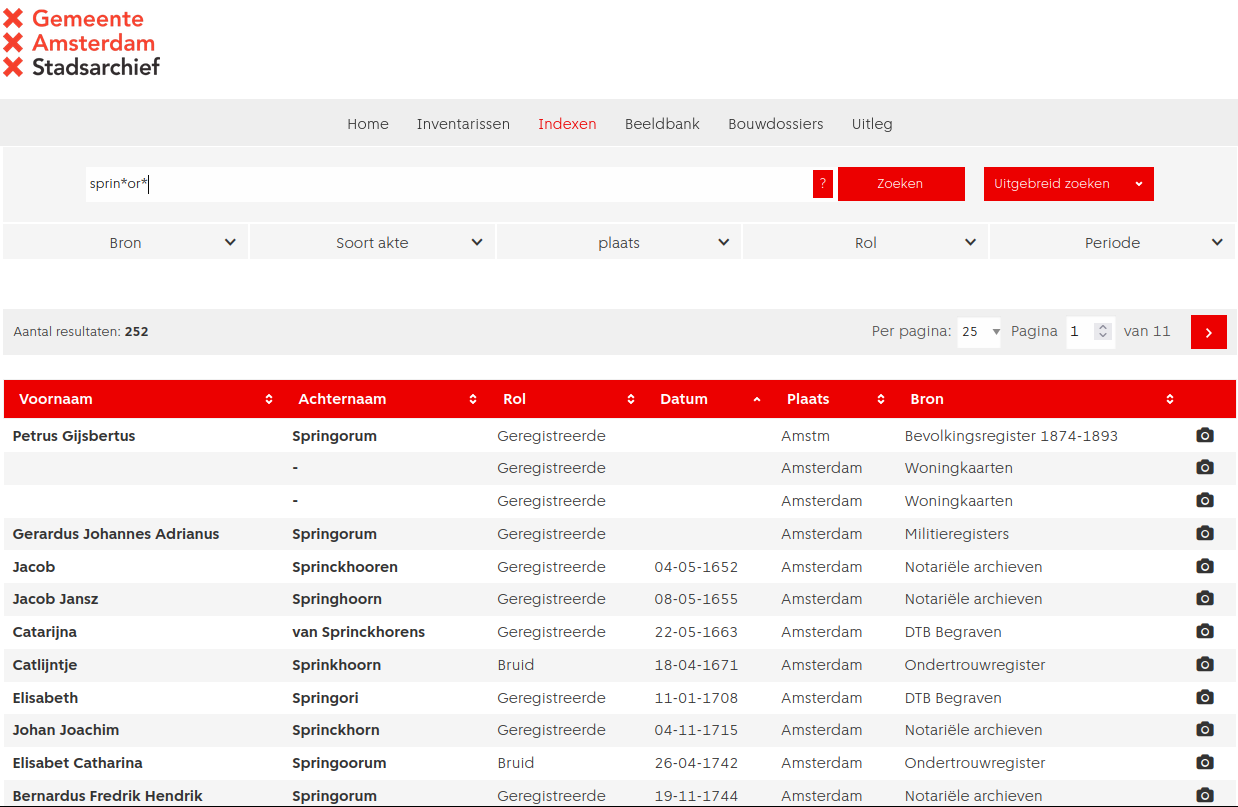 I'm very fortunate to have both a rare last name and ancestors who lived in a major Dutch city with well-organized records, including older church books. Whenever I search for the name Springorum, the results almost always lead to people from the same family tree in Amsterdam. Also here are wildcards supported in the search.
Link: https://archief.amsterdam/
Delpher
Dutch newspaper and books archive
Delpher is a free Dutch online archive that gives access to millions of digitized newspapers, books, journals, and radio bulletins from the 17th century to today. It’s an invaluable resource for researchers, genealogists, and anyone interested in Dutch history, offering powerful search tools to explore original texts and historical context.
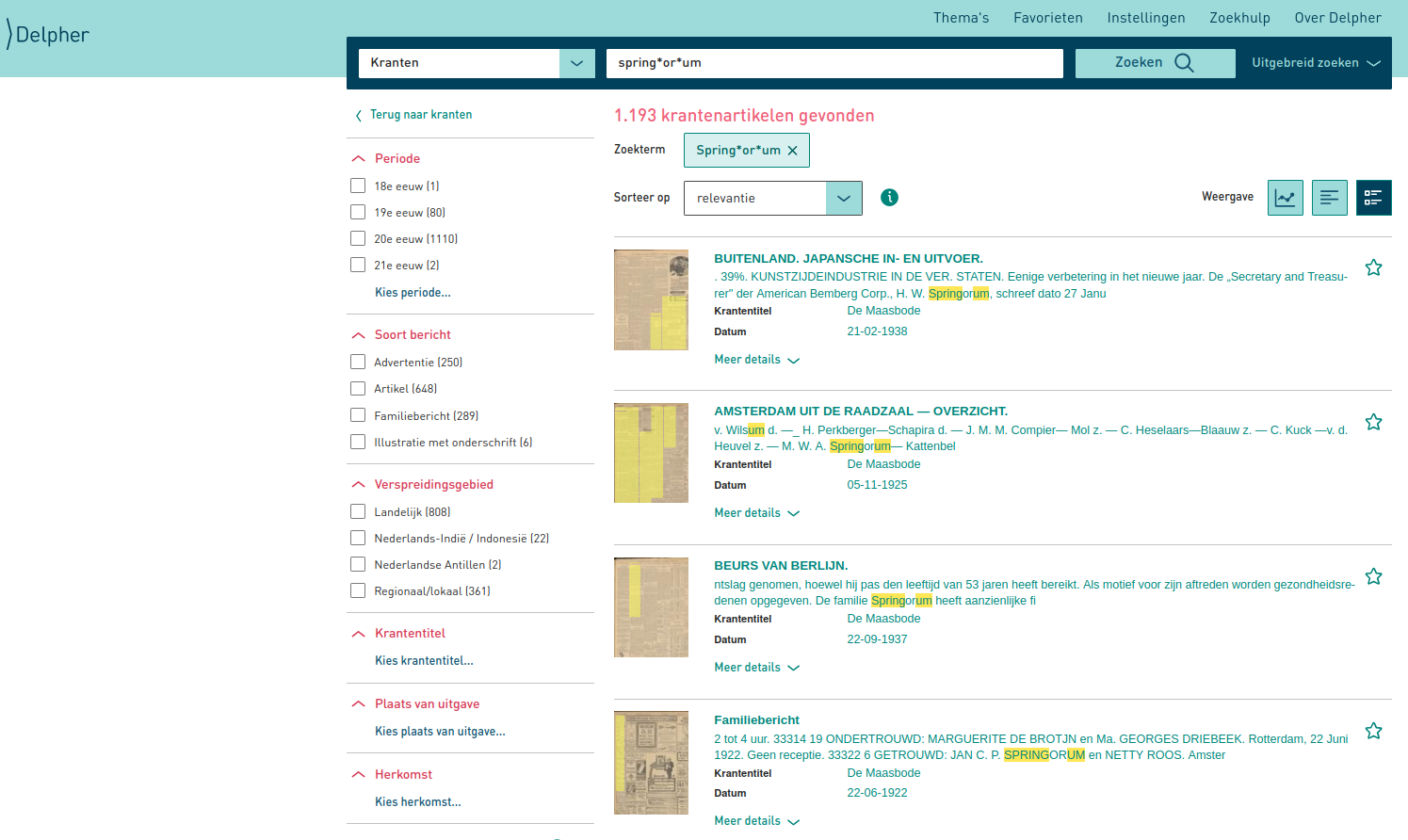 Newspapers and books often hold valuable information that doesn’t show up in a regular Google search. This dedicated site lets you search for specific words across hundreds of historical documents. However, the OCR used on this site isn’t always accurate, so I often try variations in spelling to improve the chances of finding what I'm looking for.
Link: https://www.delpher.nl/
Wie was wie
Dutch starting point for genealogy research
WieWasWie.nl is a central Dutch genealogy platform offering access to millions of historical records, including births, marriages, deaths, and passenger lists. It connects users to original documents from various Dutch archives and is an essential resource for anyone researching Dutch ancestry. (Paid version allows search using wildcards and for two people simultaneously, €50,-/year)
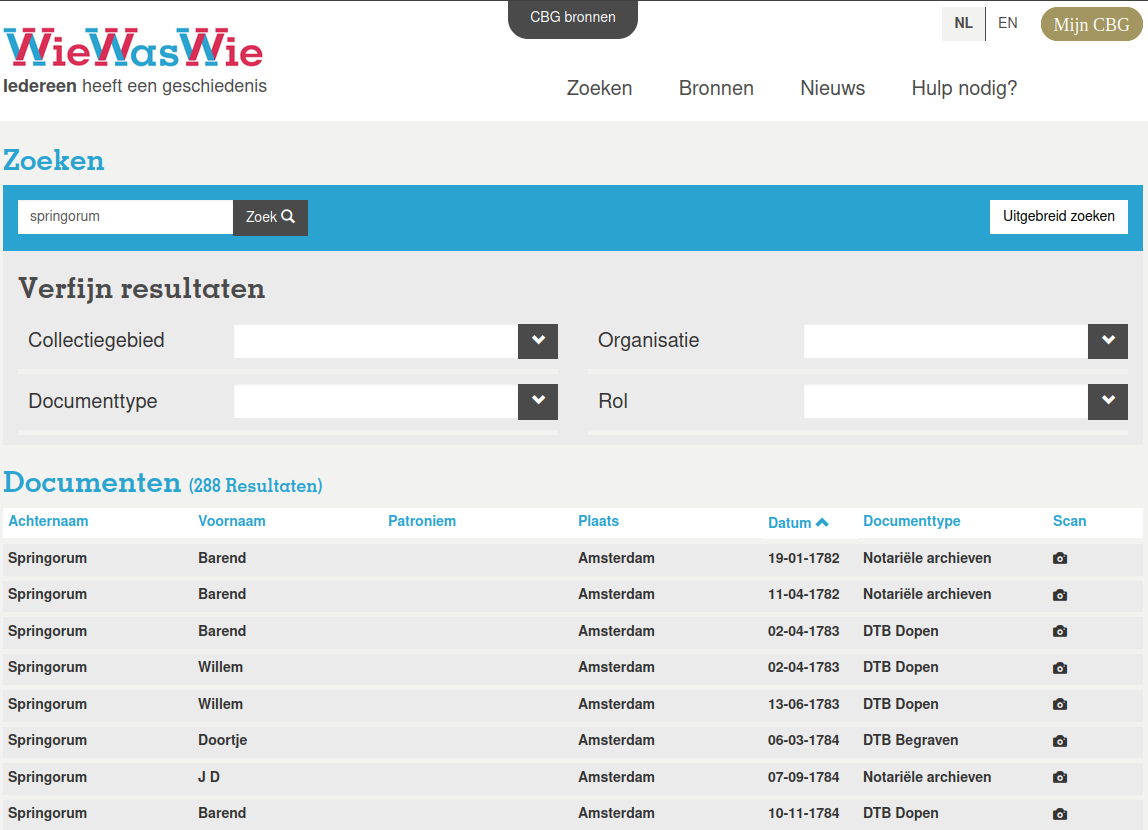 Unfortunately search using wildcards is only supported with paid subscription.
Link: https://www.wiewaswie.nl/
Archive in Nordrhein Westfalen
German archive including regions of Dortmund/Essen
Archive.NRW is the central online portal for archives in North Rhine-Westphalia, offering free access to millions of archival records and digitized documents from over 480 state, municipal, church, business, and university archives. Users can search by keyword or map, browse finding aids, view digital scans, and request materials for in-person viewing, making it a key resource for historical and genealogical research in the region.
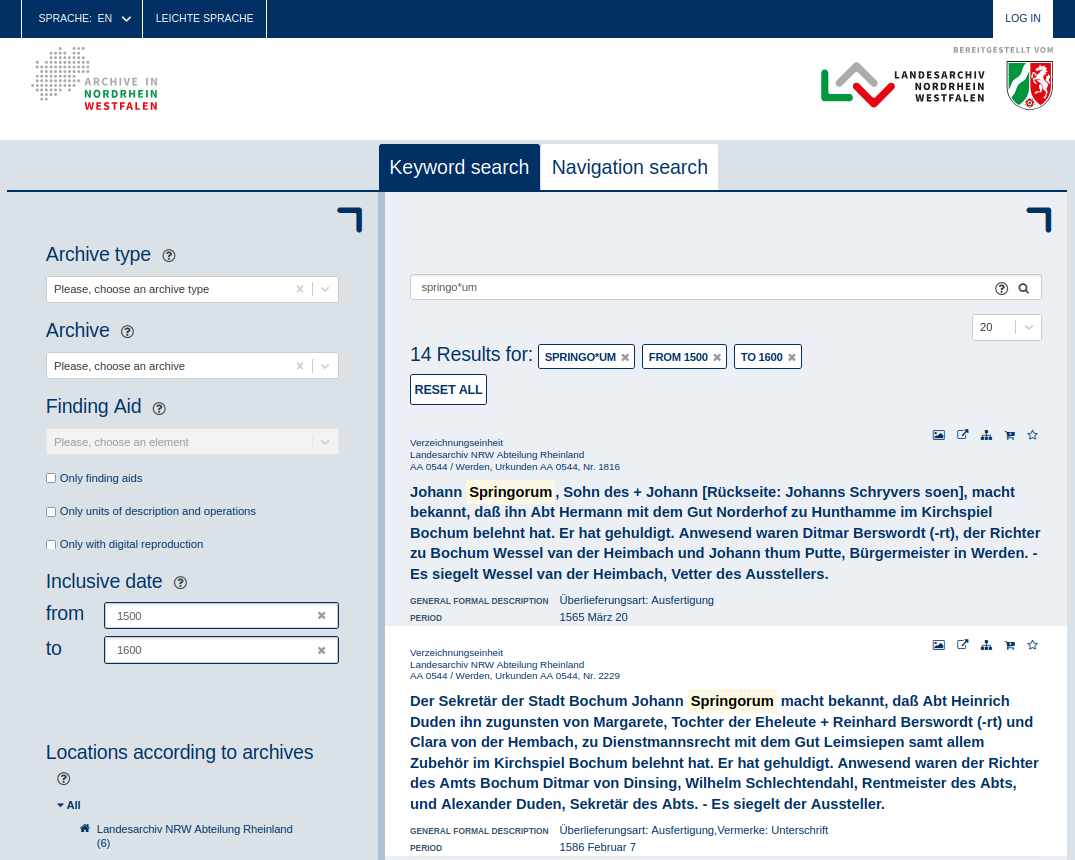 Here I found several 16th documents found holding the name Springorum.
Link: https://www.archive.nrw.de/archivsuche
Archion
German commercial archive church registrations
Archion is a paid web portal offering online access to over 175,000 digitised German church registers—baptisms, marriages, deaths—from some 25 archives, ideal for genealogical and prosopographical research. Users can search by location or archive, view and download records via short‑, medium‑ or long‑term subscription passes, and explore old‑German script materials with optional paleography aids. (Paid acces only: €19,90/month, €52,20/3-month or €178,80/year)
Link: https://www.archion.de/de/
Matricula
Free German archive church registrations
Matricula Online is a free digital archive of Catholic church records—primarily baptisms, marriages, and deaths—from Austria, Germany, Slovenia, and several other European countries, offering scanned parish registers dating back to the 16th century. Users can browse by diocese, parish, location, and timeframe, and can view or download original register images. However, these records are not indexed, so name searches aren’t possible. Instead, I’ve spent countless evenings reading through the books, manually searching for traces of my family.
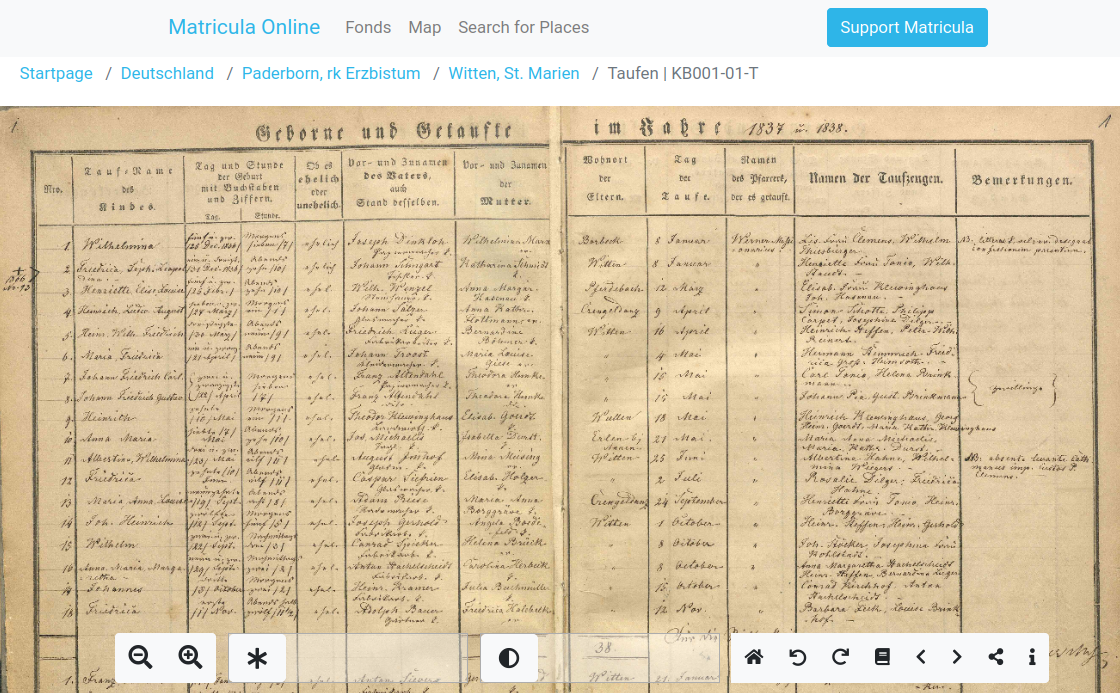 This site has given me the most useful and trustworthy church records I’ve found. It helped uncover full family trees from a small community around Henrichenburg, Recklinghausen, and Dortmund. Unfortunately this site has no records of churches in the area of Düsseldorf - Köln - Wuppertal.
Link: https://data.matricula-online.eu/en/
Wikipedia
Generic platform
Wikipedia is a free, multilingual online encyclopedia written and maintained by a global community of volunteers. Anyone can create or edit articles, and all content is collaboratively curated under a neutral point of view. Operated by the non-profit Wikimedia Foundation, Wikipedia provides reliable, citation-based knowledge on millions of topics, and is widely used for general research, education, and reference across the world.
Link: https://en.wikipedia.org/wiki/Main_Page
Various German Sites and Documents
Das Schriftwesen in Bochum bis zur Mitte des 17. Jahrhunderts
(...und das Eindringen der hochdeutschen Schriftsprache)
Dr. Günther Höfken: Beiträge zur Geschichte der Familie Springorum in der Zeit von 1700 - 1800. Im Aufträge der Fam. Springorum zusammengestellt in 1931 (?). Exemplar in Schreibmaschinenschrift im Stadtarchiv Bochum.
81 ) Höfken: Gesch . dtr Farn . Springorum . S.
Specific Personal Websites
Frank Heidermanns
Heidermanns.net is a personal genealogy website by Frank Heidermanns that hosts extensive family trees and individual profiles for the Heidermanns and related families.
Covering about 50 Springorums, starting at Johannes Springorum (1625-1694)
Link: https://www.heidermanns.net/gen-form.php?MD=pers&VF=L&FN=Springorum
de Paula Lopes
de-Paula-Lopes.nl is a personal genealogy site by Marnix Alexander de Paula Lopes, tracing family roots across Dutch, Portuguese, and colonial histories. It features detailed pedigree charts, archival documents, and original source images, offering a rich blend of research and storytelling.
Mainly focused on Captain Jan Olhoff, a VOC sailor and privateer commander of the ship De Spion, on which he sailed alongside Barend Springorum.
Link: https://de-paula-lopes.nl/
Heimatkunde Schwelm
Heimatkunde‑Schwelm.de is a community‑driven, free online archive focused on the local history of Schwelm and its surroundings. It offers downloadable documents—like 18th- and 19th-century residents’ lists, address books, and historic maps—along with images from Heimatfest celebrations, industrial sites, and everyday life. Run in close cooperation with citizens and the city archive (but not the local history association itself), it’s a rich resource for anyone researching regional heritage or genealogy in this Westphalian town.
One of the most fascinating finds was an old stamtafel (family chart) created long ago. All pages have been scanned in high resolution and contain a wealth of detail about the Springorum family tree.
Interesting pages:
-
https://heimatkunde-schwelm.de/ (Stamtafel) (Starting at Reinhard Springorum (1593-1666))
-
https://heimatkunde-schwelm.de/ (Stambaum Wagenknecht) (Starting with Johann Bernhard Springorum II (1726-1790))
-
https://heimatkunde-schwelm.de/ (Schwelmer familien) (Various Springorums, Friedrich Wilhelm Springorum (1782 - 1838))
Wupper Digitale Fotografie
The K.D. Wupper website is a personal, richly illustrated collection of historical content curated by photographer K.D. Wupper. It features high-quality photos and insights on local history, with a strong focus on churches, monuments, and regional heritage. While not an official archive, the site serves as a well-organized cultural record, offering detailed visuals and background information on various locations and artworks.
To my surprise, this site holds many high quality photographs of the many ledger stones that can be found near the Dorfkirche in Kirchende and outside the Stiftskirche in Herdecke. These stones mark the graves of prominent members of the Springorum family,
Link: https://www.kdwupper.de/herdecke_ev_stiftskirche_st_marien.html