Johann Springorum (II)
City Secretary of Bochum
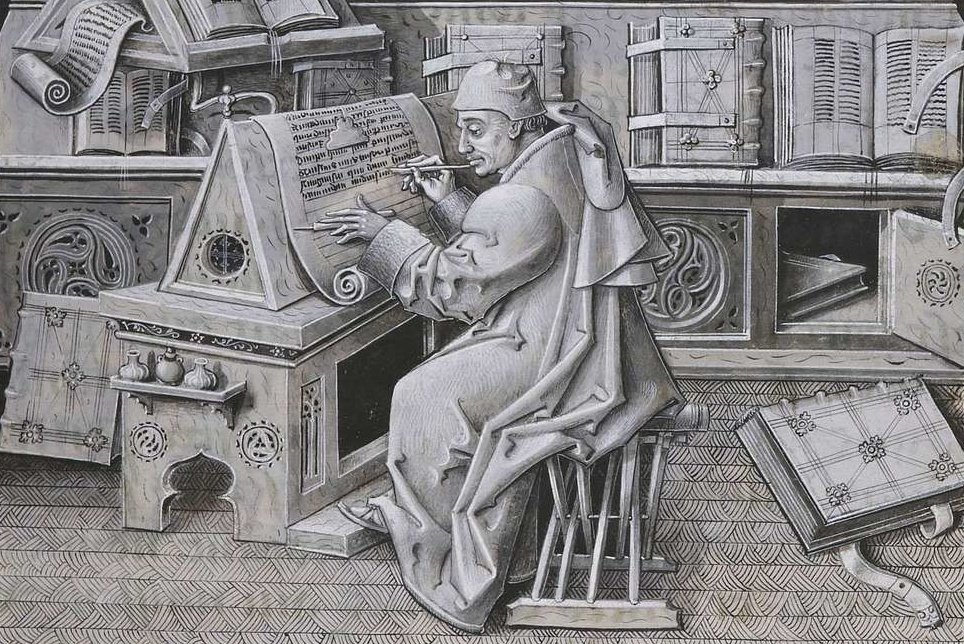
Johann Springorum (II)
With the growing influence of Roman law in the 16th century, court proceedings in Bochum shifted from oral to written form. This made the appointment of a court scribe mandatory. Chosen by the local bailiff (Schultheiß), the scribe prepared legal records as well as documents of voluntary jurisdiction such as inheritance settlements, guardianship obligations, and property contracts.
Johann Springorum (II), son of Johann Schriver genannt Springorum and Anna von Eickel, was born around the middle of the 16th century in Bochum, after 15401. His upbringing was shaped by a family already tied to civic and legal affairs. Unlike his father, who had faced exile after the fire of 1517, Johann’s life shows steady integration into city governance.
The first clear trace of him is a 1565 charter from Abbot Hermann of Werden, granting him the farm Norderloff in Hunthamme. On the reverse he is named as “Johann Springorum, son of the late Johann Schriver,” a vital link confirming his descent and status. Just three years later, during the plague of 1568, his sister Agnes made her testament, naming Johann executor and mentioning her brothers Johann, Sibertus and Diederich. This role illustrates his responsibility within the family at a moment of crisis.
From 1569 Johann entered public office as clerk of the city court. He drafted contracts, rents, and inheritance settlements, and his handwriting appears in numerous surviving charters. By 1586 he was calling himself Stadtsekretär, a title reflecting both authority and education, and at times he also served as Unterrichter (deputy judge). In the same year he was confirmed as tenant of the estate Leimsiepen by the abbot of Werden, demonstrating his position at the intersection of civic service and feudal society.
Throughout the 1590s Johann is found regularly as witness and signatory to transactions, his presence ensuring legality and continuity in Bochum’s records. The final notice of him dates from 1602, when he acted as procurator in a lawsuit over the farmstead im Holte. Even then he remained active in legal practice. His son Sibertus would later continue the tradition, becoming court clerk in 1631.
Johann Springorum (II) thus represents the consolidation of his family’s place among Bochum’s leading citizens. Where earlier generations had faced upheaval, Johann built stability as clerk, secretary, judge, and tenant, firmly anchoring the Springorum name in the civic life of the city at the threshold of the modern era.
1593 — Wennemar Kremer leaving
In 1563 the city of Bochum appointed Wennemar Kremer as schoolmaster. “Anno 1563, on the 19th of April, the mayor and council together with the Eight of the community accepted Master Wennemar Kremer into service; and should Master Wennemar henceforth no longer be agreeable to the people of Bochum, his service from the mayor and council shall be terminated with six weeks’ notice.” In the following years he occasionally helped out in the city chancery, but left most of the work to the city clerks Wessel Roffhake and Johann Springorum.
Source: Das Schriftwesen in Bochum bis zur Mitte des 17. Jahrhunderts und das Eindringen der hochdeutschen Schriftsprache (https://sammlungen.ulb.uni-muenster.de/hd/content/titleinfo/230799?query=springorum)
1565 — Proof of Johann being son of Johann Schriver
| Year | Event | Role |
|---|---|---|
| 1565 | Enfeoffment of the estate Norderhof (Hunthamme) | Feudal tenant |
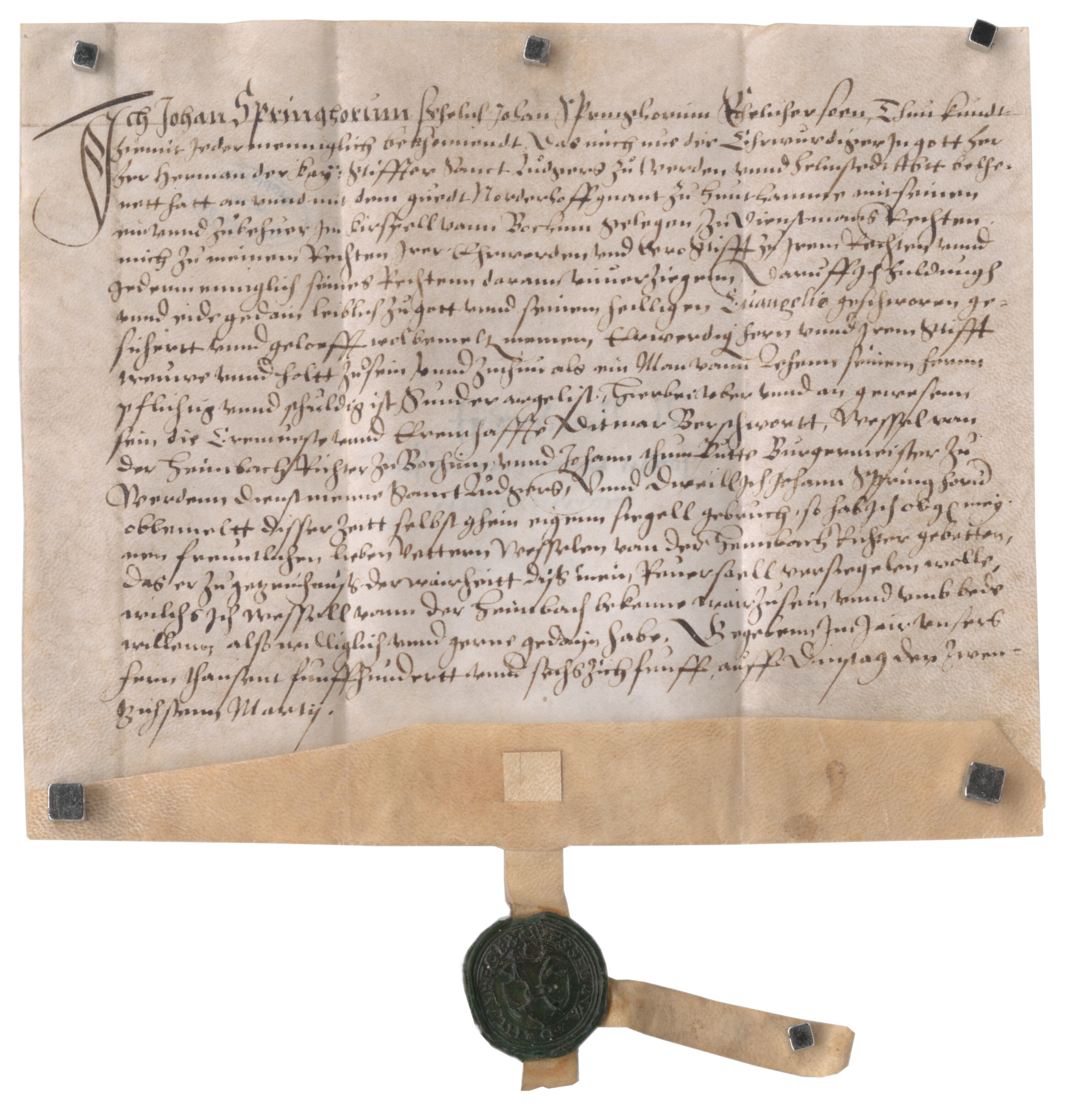
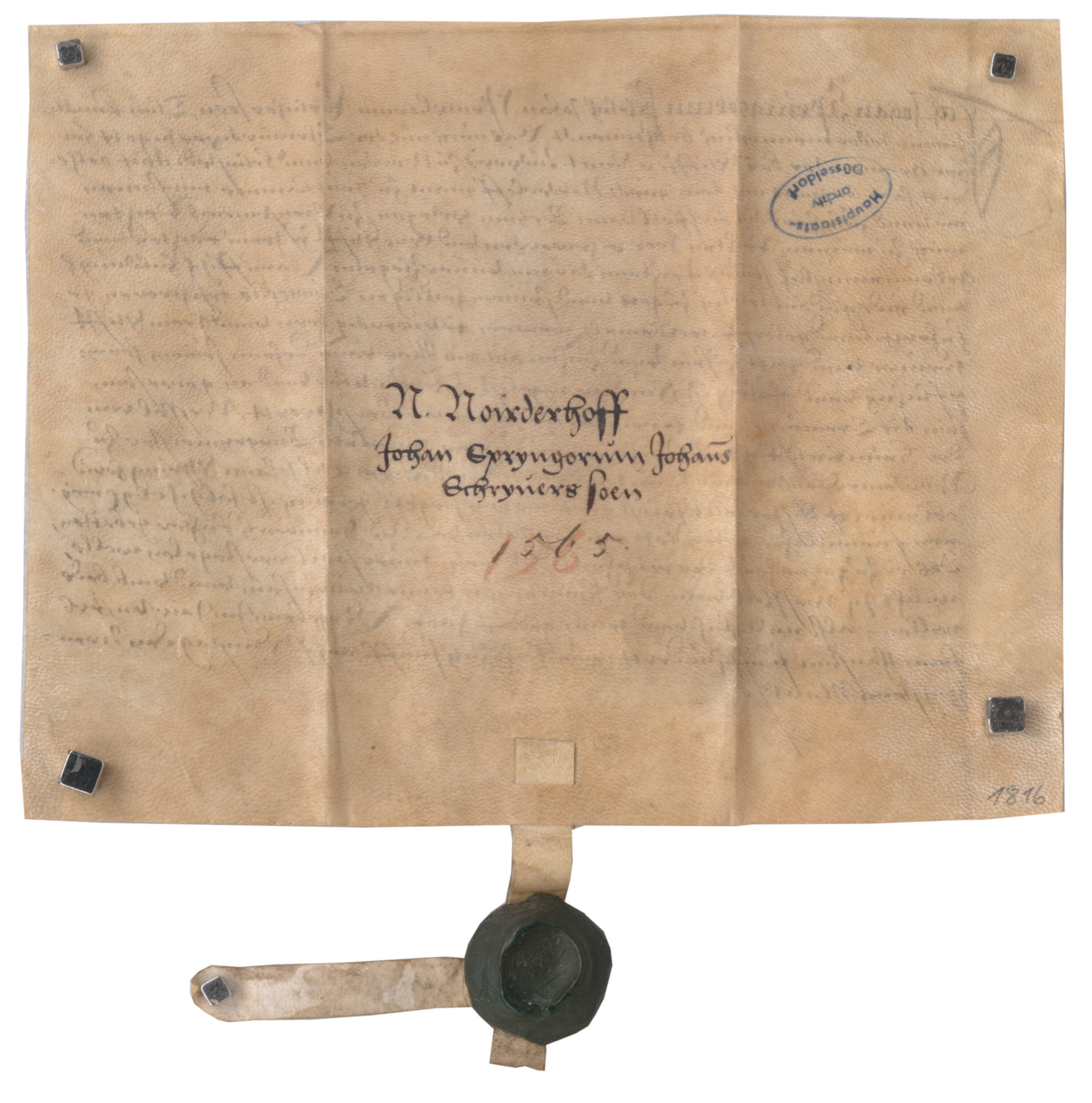
How important it is to read the documents carefully becomes clear right away from the first reference I find from 1565. There—albeit on the reverse side—it states in black and white that he is the son of the late Johann Schriver. This proves beyond doubt that Johann Springorum was the son of Johann Schriver gen. Springorum.
 |
 |
|---|
Image: On the reverse of the parchment it reads: “Johan Springorum, Johans Schryvers Soen”
I, Johann Springorum, lawful son of the late Johann Springorum, hereby make known to everyone and attest that I have been enfeoffed by the venerable Lord Hermann, imperial founder of Saint Ludgerus at Werden and Helmstedt and abbot there, with the estate called Norderloff, situated at Hunthamme with all its appurtenances in the parish of Bochum, under vassalage law.
Thereupon I rendered homage and swore an oath—personally by God and his holy Gospel—and promised to be faithful and loyal to my venerable lord and his chapter, as a liege man is bound and obligated to his lord, without deceit.
Present as witnesses were the honorable men Ditmar Berswort, Wessel van der Heimbach, judge in Bochum, and Johann thum Putte, mayor of Werden, servant of my holy Ludgerus.
And since I, Johann Springorum, at that time had no seal of my own, I asked my good cousin, Wessel van der Heimbach, judge, to seal this charter as testimony to the truth. Which I, Wessel van der Heimbach, hereby acknowledge to be true and have done willingly at his request.
Given in the year of our Lord 1565, on Tuesday 20 March.
Ich Johan Springhorum, selig Johan Springhorinn ehelicher soen, thun kund hiemit jeder menniglich, bekennendt,
dass mich nu der ehrwirdiger in Gott Herr Hermann, der kayserliche Stiffter Sanct Ludgers zu Werden und Helmstedt, Abt,
belehnet hat an und mit dem guedt Norderloff genannt, zu Hunthamme mit seinen ein und zugehör, im Kirchspiel von Bochum gelegen, zu Dienstmanns Rechten, mich zu meinem Rechten, ihrer Ehrwürden und dero Stifft zu ihrem Rechten,
und jedermanniglich seines Rechten daran unverzogen.
Daruff ich Huldung und Eide getan, leiblich zu Gott und seinem heiligen Evangelie geschworen, gesichert und gelobt,
wohlbemeltem meinem ehrwürdigen Herrn und ihrem Stift treu und hold zu sein,
unterzutun als ein Mann von Lehen seinem Herrn pflichtig und schuldig ist, sund er Arglist.
Hierbei über und an gewesen sein die ehrnesten und ehrenhafte Ditmar Berschwortt,
Wessel van der Heimbach, Richter zu Bochum, und Johann thum Putte, Bürgermeister zu Werden,
Dienste meines Sanct Ludgers.
Und dieweil ich, Johann Springhorum, obbemeltt, dieser Zeit selbst kein eigen Siegel gebraucht,
so hab ich obgemelten meinen freundlichen lieben Vettern, Wessel von der Heimbach, Richter, gebeten,
dass er zu Getzeuchnus der Wahrheit dies mein Peuersaell versiegeln wolle,
welchs ich, Wessel von der Heimbach, bekenne wahr zu sein und umb Bederwillen also williglich und gerne getan habe.
Gegeben im Jar unsers Herren, funffhundertt und sechszehn funff, uff Dinstag der zwenzichsten Martij.
Source: Record unit State Archive NRW, Department Rhineland AA 0544 / Werden, Charters AA 0544, No. 1816
1568 — Family members in will of Agnes
| Year | Event | Role |
|---|---|---|
| 1568 | Will of Agnes Springorum | Executor |
In the introduction to the previously mentioned family tree there is a reference to a will made by Agnes Springorum. After some searching I found this will, in which the names of her brothers and sister are mentioned, including the name of her brother Johann Springorum.
On 6 September 1568 Agnes Springorum made her will. Stricken by the plague, Agnes explicitly names her brothers and sister: she bequeaths 100 talers (about two years’ income at the time; approx. €90–100k today) to her brother Johann and 100 talers to her brother Gerrich; to her sister Anna she gives one gold gulden (≈ ⅔ thaler, and a thaler ≈ about one week’s wage) and her “rosette shoes,” and to Ursula, Anna’s daughter, 25 talers. After distribution of legacies and payment of debts, Agnes appoints her brothers Sibert and Dietherich Springorum as heirs to the remainder, while Johann serves as executor of her last will.
Agnes bequeaths 100 taler to the poor of Bochum. In the 17th-century poor-relief accounts this appears as the "Springorum-Spende" (Springorum Donation): each year, on the Friday after Corpus Christi, 1 malder of “duplicis” (half barley, half rye) was to be distributed to the poor.
 |
 |
|---|
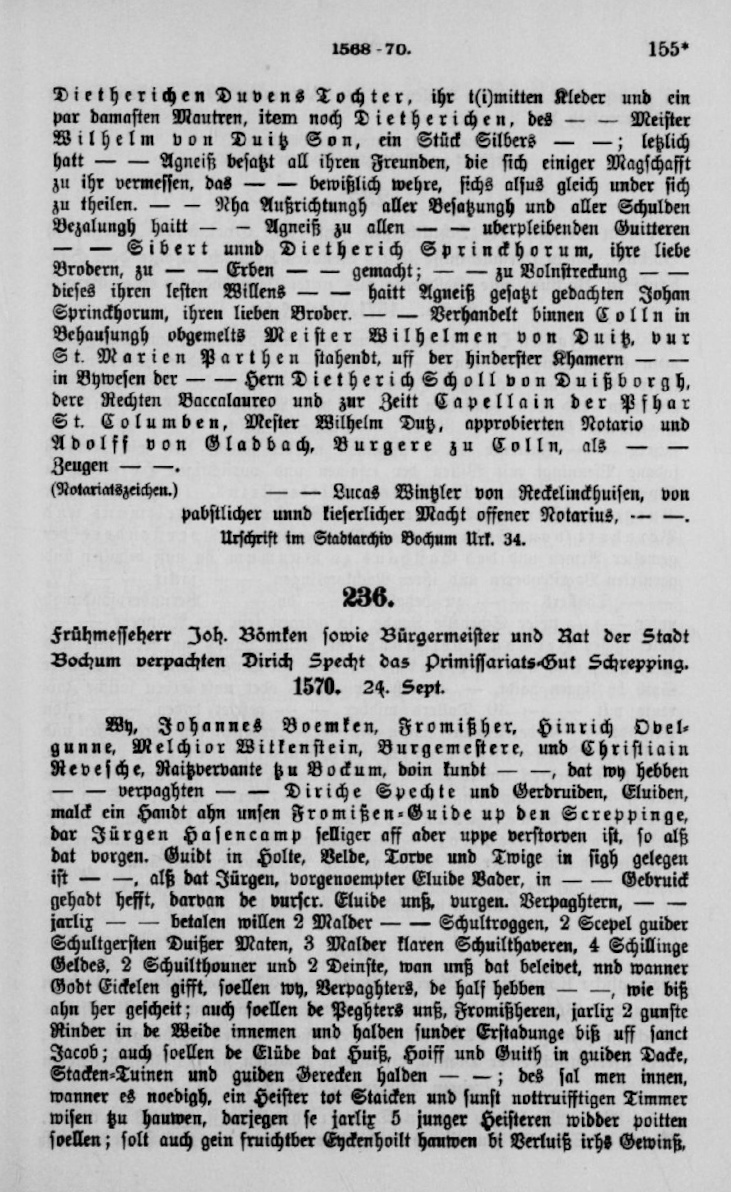
Image: No. 235; Will of Agnes Springorum (6 Sept 1568)
6 September 1568
In God’s name, amen! Let it be known to all […], that in the year […] one thousand five hundred and sixty‑eight, on Monday 6 September, at about seven o’clock in the evening, in the sixth year of Emperor Maximilian II, in my […] (notary) and in the presence of […] witnesses, there appeared the virtuous Agnes Sprinnkhorum; although weak and ill with fever and struck by the swift illness and plague, the pestilence, lying in bed, yet fully of sound mind, and, by divine inspiration, considering that all human beings are subject to death […]. Considering this, the aforesaid Agnes made this her will […]:
First, the said Agnes bequeaths to the archbishop of Cologne one tournose, to be given once, and likewise one tournose for the construction of the cathedral church of Cologne, to be given once.
Further, she wishes that the executor of her last will named below […] shall, out of all her goods, first place 100 talers with the provisors of the hospital of the poor at Bochum, to be invested as an annual rent, which is to be paid each year to a poor, devout maidservant who wishes to marry; and in case such a poor person should not be available, then the rent shall be distributed to the poor of the place.
Further, she bequeaths: to Johan Sprinckhorum, her dear brother, 100 talers; item Gerrich Spr., likewise her dear brother, 100 talers; Annen Spr., her dear sister, one gold gulden and her “rosette shoes” (reading uncertain: rossetten Fueke); Annen’s daughter, called Ursula, 25 talers; item Susen […], master […]; Dietherich Duven’s daughter, her middling‑good clothes and a pair of damask cloths; item also Dietherich, the — master Wilhelm of Dütz’ son, a piece of silver […].
Finally, Agnes provides that all her friends who can prove kinship with her […] are to divide it equally among themselves.
After execution of all legacies and payment of all debts, Agnes makes from the remaining goods her dear brothers Sibert and Dietherich Sprinckhorum heirs; and for execution of this her last will Agnes appoints her said brother Johan Sprinckhorum.
Executed at Cologne, in the house of the said master Wilhelm of Dütz, by/at the St. Mary’s gate, in the back chamber, in the presence of Sir Dietherich Scholl of Duisburg, bachelor of laws and at the time chaplain of the parish of St. Columba, master Wilhelm Dutz, approved notary, and Adolff of Gladbach, citizen of Cologne, as witnesses.
(Notarial sign.) Lucas Wintzler of Recklinghausen, public notary by papal and imperial authority.
Original charter: Stadtarchiv Bochum, Urkunde 34.
1568, 6. September
In Gottes Nhamen Amen! Kundt und zu wissen sei […], daß im Jair […] tausent vunffhundert acht und seeßzich, auf Montagh den 6. September, ungeferlich umb 7 Uhren Nachmittags, Kayserthums […] Maximiliani deß anderen, im sechsten Jare, in meines […], Notarien, und […] Zeugen […] Jegenvortigkeit erschienen ist die thugentsame Agnes Sprinnkhorum, wiewoll schwach und krank von Lew und mit der geschwinder Krenkten und Plagen, der Pestilentz, verhafft, im Bedt liggend, jedoch ihrer Synnen woll mechtigh und auß göttlicher Ingebung erwegende, daß alle Menschen dem Todt underworfen […]. In Ansehungh deß hatt vurgeschrevene Agneß diß ihr Testament gemachet […]:
Anfenklich hatt vorgedachte Agneß dem Ertzbischoffen zu Colln ein Tornisch besatzt, einmail zu geben, gleichfalß zum Bauw der Thumbkirchen in Colln ein Tornisch, einmail zu geben; wilt auch, das dieses ihres […] lesten Willens Executor […] unden benent, auß allen ihren […] Guittern zuforn 100 Thaler mit Rhaett Provisoren des Gasthuises der Armen zu Bouckum anlagen unnd ein jarliche Renth davon stiften, und dieselb jarlichs einer armer frommer Dhienstmagt, so gern zu Ehe greiffen wolle, handtreichen sollen; und ime Fall sothane arme Persone nitt vurhanden wehre, alßdan sall solche […] Renth den Gottes Armen des Ortts distribuiert werden.
Weitherß hatt sie besatzt: Johan Sprinckhorum, ihren lieben Broder, 100 Thaler; item Gerrich Spr., auch ihren lieben Broder, 100 Thaler; Annen Spr., ihrer lieber Suster, einen Goltgulden und ihre rossetten Fueke; Annen Tochter, gnant Ursula, 25 Thaler; item Susen […], Meister […]; Dietherichen Duvens Tochter, ihr t(i)mitten Kleder und ein par damasten Mautren; item noch Dietherichen, des — Meister Wilhelm von Duitz Son, ein Stück Silbers […].
Letzlich hatt Agneiß besatzt all ihren Freunden, die sich einiger Magschafft zu ihr vermessen, das — — bewißlich wehre, sichs also gleich under sich zu theilen.
Nha Außrichtungh aller Besatzungh und aller Schulden Bezalungh haitt Agneiß zu allen — — uberpleibenden Guitteren Sibert unnd Dietherich Sprinckhorum, ihre lieben Brodern, zu — — Erben — gemacht; — zu Volnstreckung dieses ihren lesten Willens — — haitt Agneiß gesatzt gedachten Johan Sprinckhorum, ihren lieben Broder.
Verhandelt binnen Colln in Behausungh obgemelts Meister Wilhelmen von Duitz, vur St. Marien Parthen stahendt, uff der hinderster Khamern, in Bywesen der Hern Dietherich Scholl von Duißborgh, dere Rechten Baccalaureo und zur Zeitt Capellain der Pfhar St. Columben, Mester Wilhelm Dutz, approbierten Notario, und Adolff von Gladbach, Burgere zu Colln, als Zeugen.
(Notariatszeichen.) Lucas Wintzler von Reckelinckhuisen, von pabstlicher unnd kieserlicher Macht offener Notarius.
Urschrift im Stadtarchiv Bochum, Urk. 34.