Didrig Springorum (1732 - 1810)
the Merchant
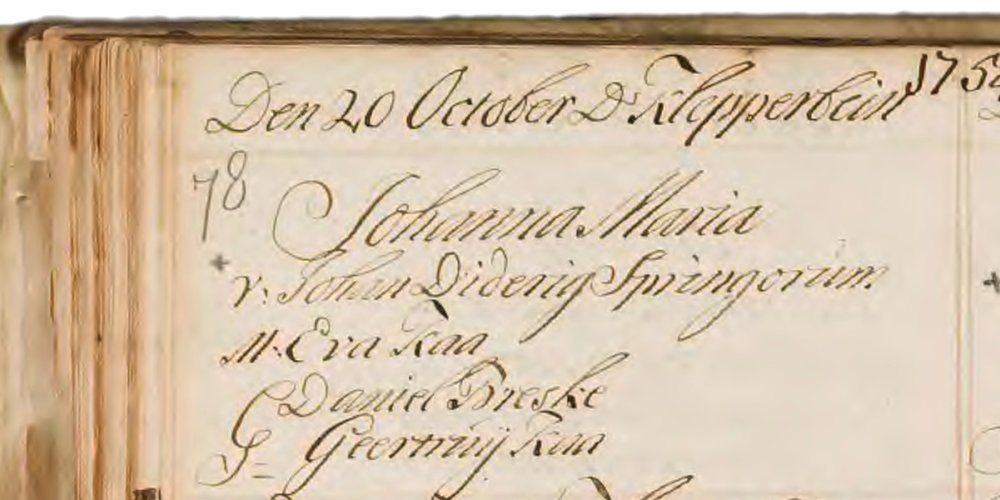
Image: Didrig Springorum's name first appears in the baptism record of his daughter Johanna Maria Springorum (20 Oct 1754).
Didrig Springorum
Didrig is not a direct ancestor of mine, but his name appears several times in the Amsterdam city archives—just before the names of Willem Springorum and Barend Springorum show up. Didrig is ten years older than Barend, and the two are second cousins, sharing the same great-grandfather: Johannes Springorum, the pastor in Kirchende. It’s quite possible that Barend and Willem followed their cousin Didrig when they moved to Amsterdam.
Johannes Dietherich (Joan Didrig) Springorum was born in Herdecke in 1732 to Johann Bernhard Springorum and Gertrud Elisabeth Brenschede. Herdecke lies just 25 km from Henrichenburg, the birthplace of Barend and Willem. Didrig was likely named after his older brother, Johann Dietrich, who died at the age of three and a half earlier that same year—a common practice at the time, when parents often reused the names of deceased children.
At a young age, Didrig moved to Amsterdam as we see the first documents mentioning his name already in 1754.
Didrig, the Unmarried Father of Johanna Maria
The earliest record I’ve found in Amsterdam mentioning Didrig Springorum is the baptism of his daughter, Johanna Maria Springorum (1754-1755), born to Didrig and Eva Kaa (1725-1797). At the time, Didrig was 22 years old and Eva was 29. Johanna Maria was baptized in the Lutheran Church but sadly passed away within six months of her birth. So far, I haven’t found any evidence that Didrig and Eva were ever married.

Image: Death record of daughter Johanna Maria Springorum (21 Nov 1755).
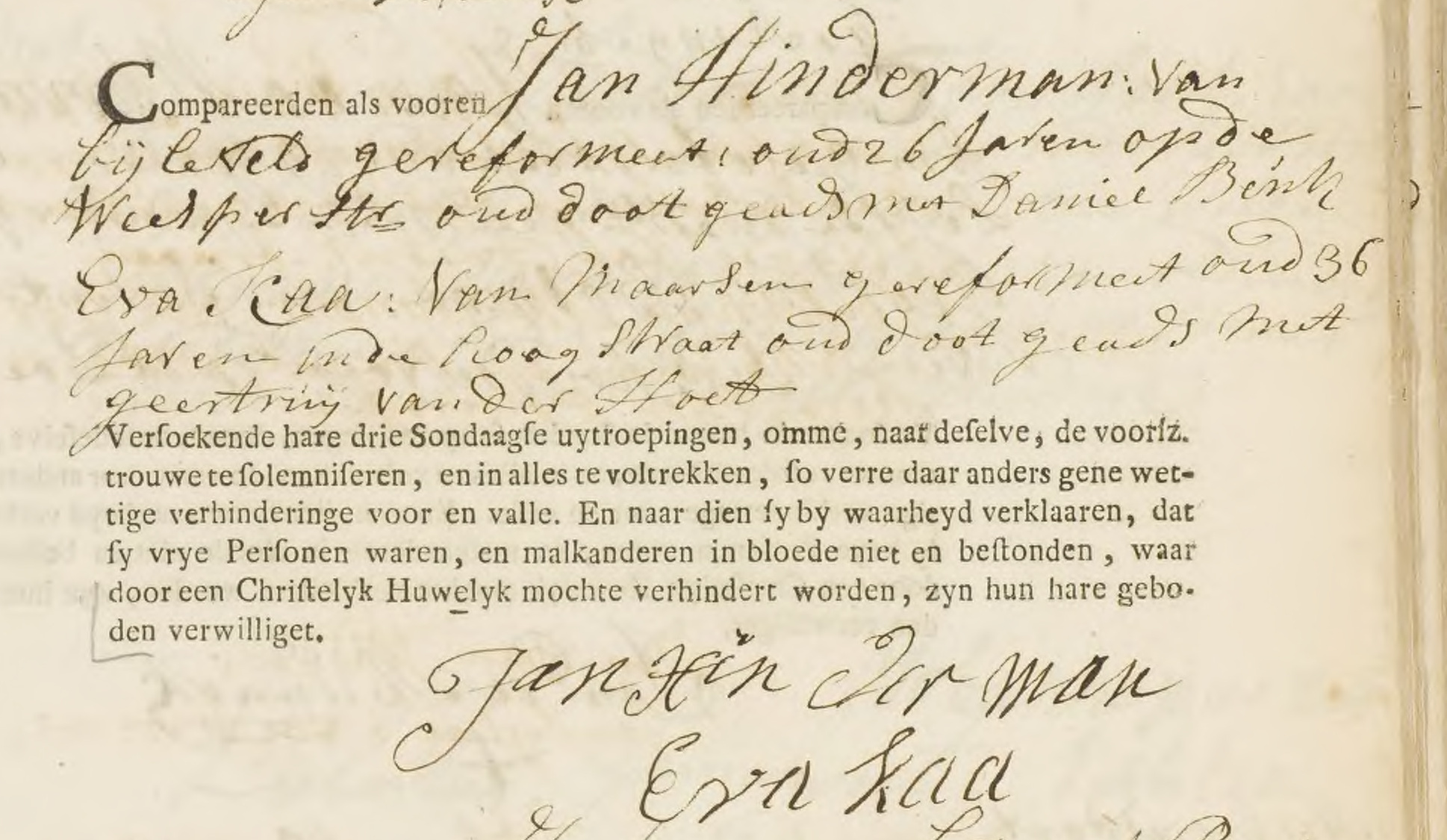
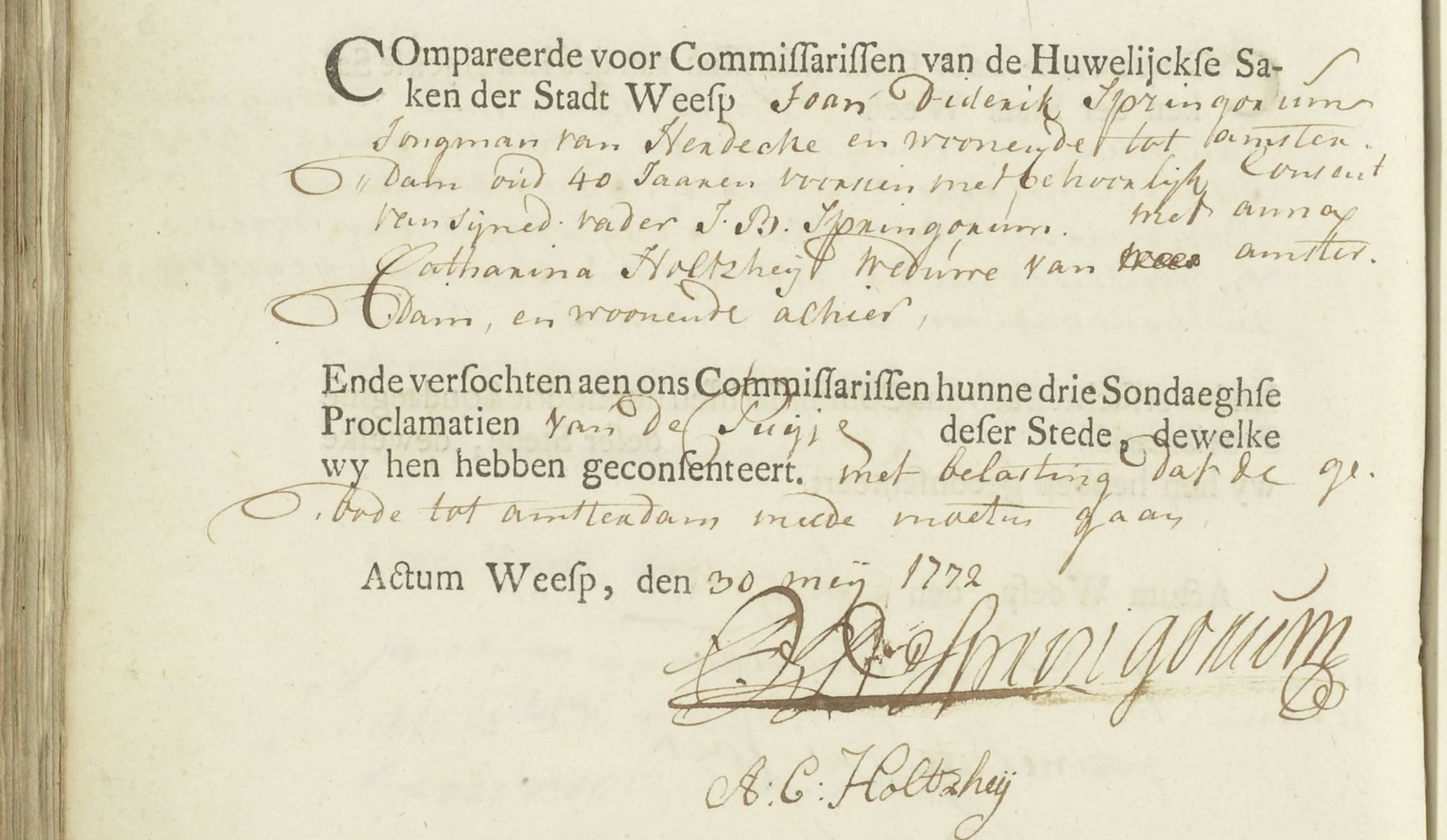
In my search for any record of a marriage between Didrig and Eva, I found nothing to confirm they were ever married. However, I did find separate marriage records for both of them—but not to each other. In 1764, Eva Kaa married Jan Hinderman (1738-?). Eight years later, in 1772, Didrig Springorum married Anna Catharina Holtzhey, the widow of Nicolaas Albrecht, who had died less than a year earlier. At the time of her marriage to Didrig, Anna Catharina had an eight-year-old daughter from her previous marriage.
 |
 |
|---|
Image: Marriage records of Eva Kaa & Jan Hinderman at the left (20 Apr 1764) and Didrig Springorum & Anna Catharina Holtzhey at the right (30 may 1772).
Den 20 April 1764,
Jan Hinderman, van Bijleveld, gereformeert, oud 26 jaren, op de Weesperstraat, oud doot geadsisteerd door Daniel Benk.
Eva Kaa, van Maarsen, gereformeert, oud 36 jaren, in de Hoogstraat, oud doot, geadsisteerd met Geertruij van der Hoet.
Joan Diderik Springorum, jongman van Herdecke en wonende te Amsterdam, oud 40 jaren, voorzien met behoorlijke consent van zijn vader J.B. Springorum.
Met Anna Catharina Holtzheij, weduwe van Nicolaas Albrecht, afkomstig van Amsterdam, en woonende alhier.
Actum Weesp, den 30 meij 1772
"Oud doot" is a fixed phrase found in old registers and likely means "previously known" or "formerly" (possibly indicating widowhood, but in context it mainly suggests that the person was already known in the city or parish).
"Geadsisteerd door/met" means that the individuals were accompanied at their betrothal by someone—usually a relative, guardian, or close acquaintance—who stood as a witness or supporter.
The phrase "voorzien met behoorlijke consent van zijn vader" (provided with proper consent from his father) is unusual, given that Didrig was 40 years old at the time. It may have been included as a formality, or because his father still held influence over family affairs. But the most likely explanation is that his father, Johann Bernhard Springorum, a Rathsman (councilman) in Herdecke, had traveled to Amsterdam to personally witness and give his approval for the marriage—an act that would have carried social and symbolic weight.
Didrig the Merchant
After the loss of his daughter, Didrig is mentioned several times in Amsterdam notarial acts between 1755 and 1768. He is described as a merchant, including in a shipping declaration from 1755 stating that he personally transferred dyewood from a ship to his own sloop to deliver it to a customer. In a summons from 1761, he is urged to hurry with the delivery of three barrels of goods, to which he seems to respond immediately. His name also appears in bill protests and a receipt as the recipient of a wage.
1755, 11 juli – Ship's declaration
This notarial deed describes the precise circumstances that led to the shipping documents concerning a shipment of dyewood not being signed, or not being signed correctly.
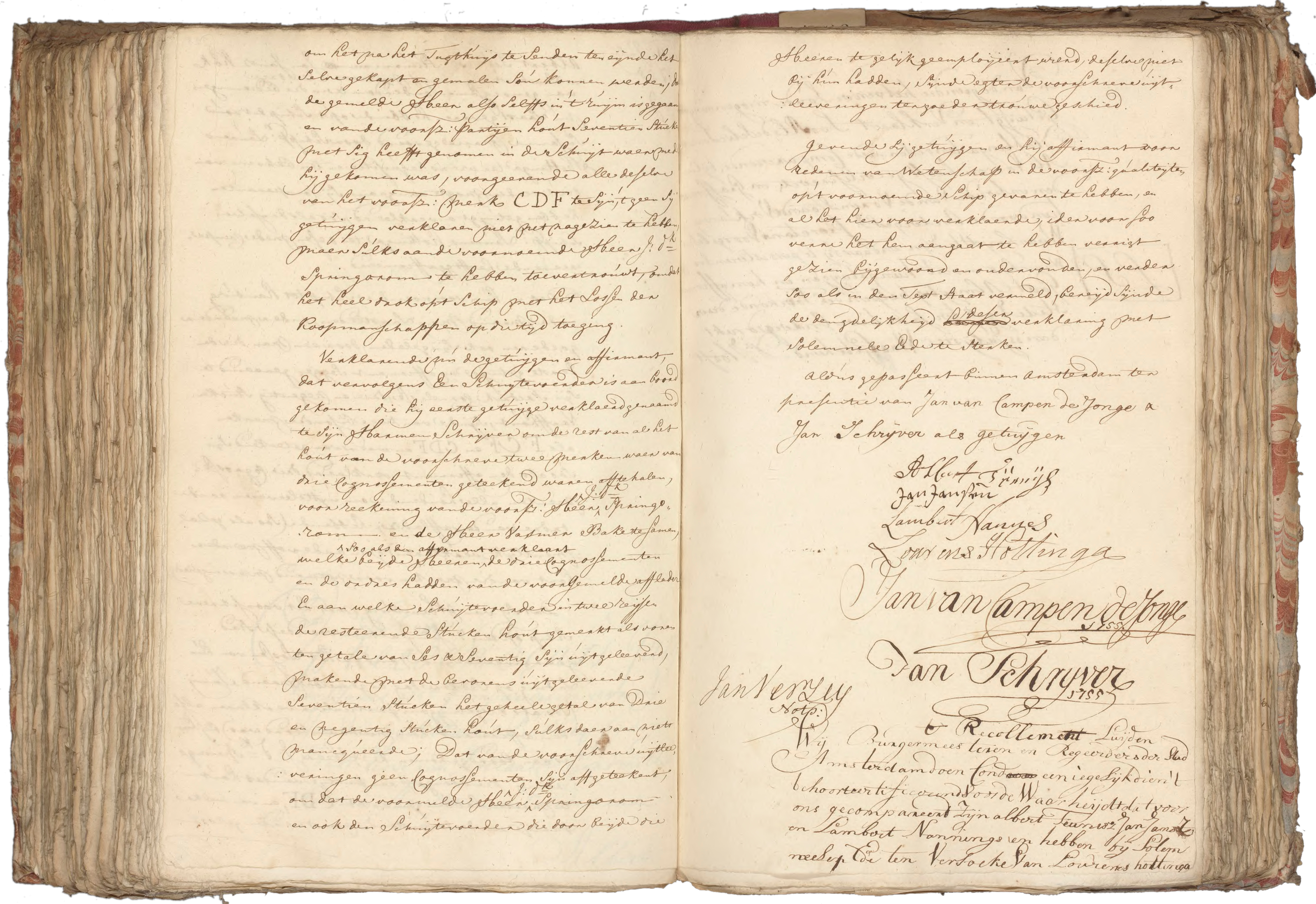 Image: Ship's declaration (11 jul 1755).
Albert Teunisz, helmsmen, Jan Jansz Kok, and Lambert Nannings, all men of sufficient age and experience as sailors, having recently served aboard the ship De Vrouw Susanna Maria under the command of Captain Laurens Hottinga, do hereby declare, at the request and for the benefit of interested parties, the following:
In the month of May this year, there were laden aboard the aforementioned ship, in the port of Hamburg, together with other goods, ninety-three pieces of dyewood. This shipment was delivered by a man who, according to the first witness and corroborated by others, is named Frederik Cornelisse. The wood bore two distinct marks, to wit, FCF and CDF, as specified on three bills of lading. These documents indicated that the cargo was to be delivered to the order of the sender. The witnesses affirm that no other wood bearing these marks, destined for other parties, was loaded onto the ship.
On the 7th day of June, the ship arrived here in Amsterdam. Whilst the unloading of cargo was underway during that same month (and in the absence of the captain from the ship), one Mr. **J.D. Springorom** came aboard. He declared that he was to receive a portion of the wood marked CDF. A part thereof, he stated, was to be immediately unloaded and conveyed to the House of Correction (Tuchthuis), there to be cut and ground. Mr. Springorum himself entered the hold and selected seventeen pieces of the wood, which he carried away in the vessel that had brought him. He declared that all these pieces bore the mark CDF. The witnesses acknowledge that they did not carefully verify this but relied upon Mr. Springorum’s assertion, as the unloading of cargo was, at that moment, particularly bustling.
Subsequently, a boatman named Harmen Schriver came aboard to collect the remaining pieces of wood bearing the two aforementioned marks. This he did on behalf of Messrs. Springorum and Vasmer Bake, who together held the three bills of lading and the corresponding orders. The boatman removed, in two journeys, the remaining seventy-six pieces of wood, thereby completing the full tally of ninety-three pieces.
The witnesses declare that no bills of lading were signed upon delivery, as neither Mr. Springorum nor the boatman carried such documents at the time. Nonetheless, the delivery was made in good faith and to the best of their knowledge and conscience. The witnesses and the captain base their testimony on their experience and personal involvement with the ship and the events herein described, and they are prepared to affirm the truth of their declaration under oath. This declaration was made in Amsterdam, in the presence of Jan van Campen the Younger and Jan Schrijver as witnesses.
Click to expand
Albert Teunisz, stuurman & Jan Jansz Kok en Lambert Nannings, matroos, alle drie van genaegsamen onderdom in die bediening in 't laast gevaren hebbende op’t Schip de vrouw Susanna Maria, gevoerd door Schipper Laurens Hottinga, ten wiens requisitie ten behoeve van die verder magte aangaam, Sy Compananten, hebben getuygt en venklaerd, soo als den selven Schipper Laurens Hottinga te dezen mede Compareerende heeft geaffirmeerd:
Dat in hun voonnoemde Schip tot Hamburg in de Maand May laastleden, onder meer den goederen ook syn geladen, door een man die den eersten getuyge en affirmant zeggen genaemt te zijn Hendrick Cornelisse, drie en negentig stucken verffhout, zynde van twee bijzondere merken als FCF en CDF, en waar van getekende Cognossementen alle houdende om uyt te leveren aan de ordres van de afzenders; hebbende, soo als ge raamentlijck verklaren, geen ander off vreemde conte van die merken van iemand ingeladen.
Dat sy van Hamburg met het voorns. Schip op den 7den Juny alhier voor dese stad gekomen zyn, zynde, onder het lossen van hun lading op sekeren dag in gemelde Maand Juny (soo als de getuygen particulier verklaren, also den affirmant toen niet aan boord was), by hun aan boord gekomen de Heer J. de Springorum, om die voorgaefde partye van dat hout gemerkt CDF te ontfangen, en van welke partye een deel aenstonts moest worden gelost om na het Tugthuys te senden ten eynde het selve gekapt en gemalen sou konnen werden.
De gemelde Heer is also selffs in ’t ruim gegaan en heeft van de voorn. partije hout zeventien stucken met sig genomen in de schuyt waar mee hy gekomen was, voorgevende alle deselve van het voorn. merk te zijn, ’t geen sy getuygen verklaren niet nagezien te hebben, maer sulcks aan den voornoemde Heer De Springorum te hebben toevertrouwt, om dat het heel drok op’t Schip met het lossen der koopmanschappen op die tyd toeging.
Verklarende in dese de getuygen en affirmant dat vervolgens een schuytevoerder is aan boord gekomen, die hy, eerste getuyge, verklaart genaemt te zijn Harmen Schriever, om de rest van al het hout van de voorsz. twee merken — waar van drie Cognossementen getekent waren — af te haelen, voor reekening van de voorsz. Heer De Springorum en de Heer Vasmer Bake tesamen, soo als den affirmant verklaart, welke beyde de drie Cognossementen en de ordres hadden van de voormelde afladers.
En aan welke schuytevoerder in twee reysen de resterende stucken hout, gemerkt als voren, ten getale van **zes en zeventig**, zijn uytgelevert, makende met de bevorens uytgeleverde **zeventien stucken** het geheele getal van **drie en negentig stucken hout**, sulcks daer aan niets mancqueerde. Dat van de voorsz. uyt leveringen geen Cognossementen zijn afgeteekent om dat de voormelde Heer **De Springorum** en ook den schuytevoerder, die door beyde de Heeren te gelyck geëmplyeert wierd, de selve niet by hun hadden. Sijnde egter de voorsz. uytleveringen ter goeder trouwe geschied.
Gevende sy getuygen en hy affirmant voor redenen van wetenschap, in de voorsz. qualiteyten op’t voornoemde Schip gevaren te hebben, en al het hier voor verklaerde, yder voor soo verre het hem aangaat, te hebben verricht, gezien, bijgewoond en ondervonden; en verder soo als in den Text staat vermeld, bereyd sijnde de deugdelijkheid dezer verklaring met solemnele Eede te sterken.
Aldus gepasseert binnen Amsterdam, ter presentie van Jan van Campen de Jonge en Jan Schrijver als getuygen.
Click to expand
Didrig
After 38 years of marriage, Joan Didrig passed away on August 6, 1810, following a brief illness.
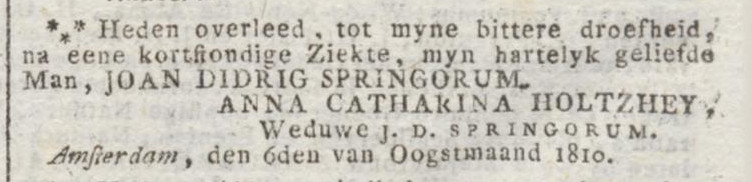
Image: Death notice placed by Anna Catharina Holtzhey after the death of her husband Joan Didrig Springorum (6 aug 1810).
Oproep notarissen https://www.delpher.nl/nl/kranten/view?query=spring%2Aor%2Aum&page=1&coll=ddd&sortfield=date&identifier=ddd:010720623:mpeg21:a0011&resultsidentifier=ddd:010720623:mpeg21:a0011&rowid=3
Notes:
Machtiging on October 7, 1780 Registered
- Hendrik Kaa
- Wupke Tonnis
- Anthonij Kaa
- Jan Hinderman
Remark
Notaris: Anthony Mijlius Locatieomschrijving: Groningerland Locatieomschrijving: Beerta in het Old Ampt van Groningerland Onderwerpsomschrijving: Afhandelen nalatenschap Taal: nederlands
Burial on August 19, 1783 Registered
- Jan Fredrik Hinderman
Remark
Begraafplaats: Karthuizer Kerkhof
Attestatie on November 18, 1800 Registered
- Johannes Josephus Hombag
- Jan Vreedenburg
- Catharina Nieuwenhuijzen
- Martha Woordman
- Jan Hinderman
- Grietje Lammers
- Johannes Pieter Willem Hombag
- Albertus Hombag
Remark
Notaris: Mr. Gerrit Buijskes Onderwerpsomschrijving: Onbetamelijk gedrag zonen
Others: 9 jul 1756: Notice of marriage Jan Hinderman x Caatje Carels (this Jan cannot write) Attestatie on September 16, 1761 Notaris: Mr. Matthias Temminck Onderwerpsomschrijving: Caatje Carels is simpel en van haar verstand beroofd Taal: nederlands