Research Tools
My Research Toolkit
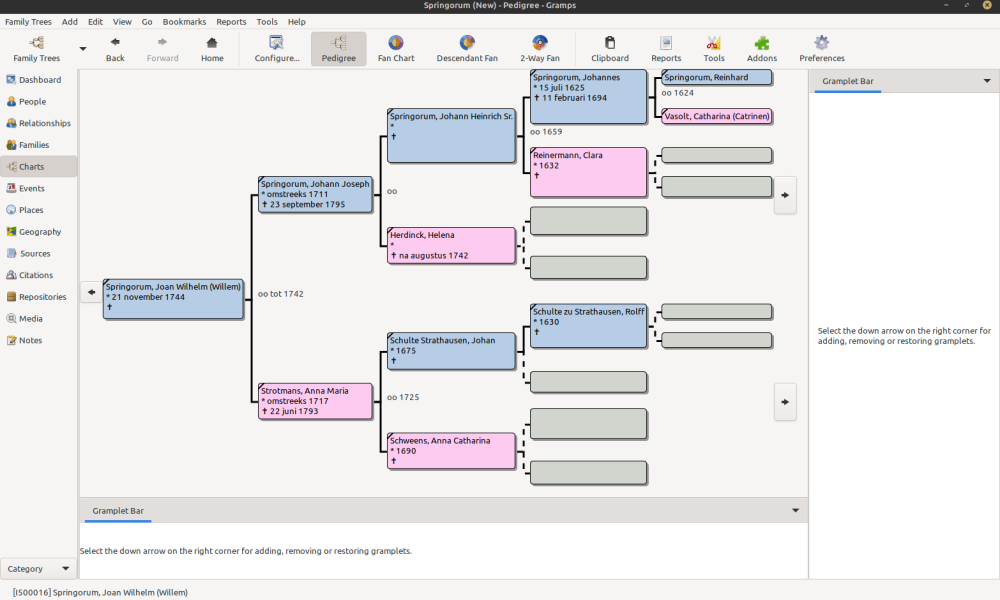
Image: Gramps puts me in complete control of every record.
Welcome to My Research
This page is the behind‑the‑scenes pass into my personal genealogy and archival research approach. This page is both a guide and a toolkit—offering the links, tips, and tools that I use to dig into the archives and build our family narrative. I hope it inspires and supports your own research journey!
a brief overview of my approach
Fast start
I began my research on MyHeritage, a commercial genealogy platform with a valuable smart matches feature that quickly identifies possible connections in other family trees. Since the name Springorum is rare, I was able to find matching records quickly and build two separate branches: the descendants of Reinhard Springorum in Germany, and my ancestors traced back to Willem Springorum in Amsterdam.
Unfortunately, I discovered many incorrect connections—children listed as being born before their fathers, brothers with age gaps of more than 50 years, and the same person duplicated and linked to multiple sets of parents. This made it clear that I needed to start verifying every result I found.
Searching for evidence
As the next logical step, I turned to online archives to verify my findings. I first familiarized myself with the different archives available in the Netherlands and Germany. Then I searched church books for birth and baptism entries and consulted population registers. I spent countless hours poring over non-indexed documents, scanning page after page for any mention of the Springorum name.
Connecting the trees
A major part of my work involved trying to link the “Amsterdam” branch with the “German” branch of the family. An important DNA match finally provided the missing link, allowing me to merge the two trees into one continuous lineage.
Consolidate the results
Over time, I documented my research in spreadsheets and text files, keeping notes of every discovery. Eventually, I decided to create a dedicated website to share my findings, and make them accessible to others.
For now, this site is hosted on my personal server—another one of my hobbies. In the future, I may move it to a professional hosting provider.
Quality and Quantity
I’ve come to realize that building a fully complete and perfectly accurate family tree is an unattainable goal. Much of the data—especially on my Springorum site at MyHeritage—remains unverified. In contrast, the information on my Springorum site at Geneanet offers a more polished and fact-checked version of at least the direct male family line, free from questionable inherited data, as it is taken directly from my personal Gramps files. Therefore, I’ve set the following priorities for my research:
- The direct male family line starting with Reinhard Springorum
- My own direct male ancestors
- Extended family members who carry the Springorum name
- Direct ancestors with other surnames
MyHeritage mainly serves as a source of new leads for my research. When new connections are discovered, I verify the information, consolidate the records offline in Gramps, and then export them to Geneanet.
TOOLS
Gramps
Free offline open-source genealogy software program
Gramps is a free, open-source genealogy program designed to help users record, organize, and analyze family history. It offers tools to store detailed information about individuals, relationships, events, and sources, and supports exporting data in standard formats for sharing or backup. Available for Windows, macOS, and Linux, it is popular among both hobbyists and professional genealogists.
After starting my research using only online tools, I soon found myself limited when trying to manage the details stored in various GEDCOM attributes. Some records had inherited long lists of questionable source information. Switching to an offline tool gave me full control over every piece of data in each record. With Gramps, I can quickly export everything as a GEDCOM file and just as easily upload it to Geneanet.
Gramps aligns perfectly with my personal approach to computers and the internet. I’ve been a Linux user since switching from Windows in 2006, and I actively promote free, high-quality, non-commercial tools.
Link: https://gramps-project.org/blog/
MyHeritage
Commercial web-based online genealogy site
The MyHeritage “Springorum” family site is a public, subscription-based online family tree hosted on MyHeritage, where the family’s genealogical data—names, dates, relationships, photos, and historical records—is compiled and shared among invited members. It integrates tree-building tools, access to billions of global historical records and DNA match features (with a free trial then premium subscription). (Free limited to 250 persons/500MB, no smart matches, €108.96/year for 2500 persons/1GB, €182.04/year for unlimited number of persons/30GB)
The advantage of an online genealogy platform is that information is instantly shared and compared with hundreds of other family trees, which can greatly speed up the search for your ancestors—branches often appear automatically. However, caution is needed. I’ve come across several cases of incorrect connections between people that were then blindly copied into other trees. So while I do use these tools, I always verify the information myself—especially the parts I care most about, like the direct male line starting with Reinhard Springorum, the earliest confirmed ancestor to carry the Springorum name.
Link: https://www.myheritage.nl/family-trees/springorum/
Geneanet
Web-based online genealogy site
The Geneanet “Springorum” family site is my public, online family tree hosted on Geneanet, where genealogical data—names, dates, relationships, and documents—are shared and expanded more collaboratively, especially with a focus on European sources from Germany, France, and the Netherlands. The platform includes powerful tree-building tools, access to millions of user-contributed records, regional archives, and historical data, with a freemium model: free for basic use, and €50/year for premium features like advanced search, Sosa numbering, record alerts, and extended storage.
The strength of using a platform like Geneanet lies in how easily information can be shared and compared with thousands of related family trees—connections often emerge without needing to search manually. But this also comes with risk: I’ve seen incorrect links copied uncritically across multiple trees. So while I rely on these tools to grow the tree and spot new branches, I always double-check the details myself—especially for core lines like the direct male descent from Reinhard Springorum, the earliest confirmed bearer of the Springorum name.
Link: https://gw.geneanet.org/rtspring_w
TransKribus
AI supported handwriting recognition
Transkribus is an AI-powered platform for transcribing historical documents, especially handwritten or early-printed texts. It uses Handwritten Text Recognition (HTR) to convert scanned pages into editable, searchable text. You can upload images, perform layout analysis, and apply pre-trained or custom models to automate transcription. Transkribus offers both free and paid plans depending on usage. (Free using standard AI text recognition, €99,-/year using super models and advanced AI tools.)
Reading old documents can be incredibly challenging. When I first started my research, I would spend entire evenings trying to transcribe a single notarial record. With Transkribus, that process now takes just a few minutes. For the most difficult texts—like 17th-century birth records from St. Nicolai Church in Dortmund—I even used the paid version that uses the most advanced trained models.
Link: https://app.transkribus.org/
ChatGPT
Generic AI assistent
ChatGPT is a tool created by OpenAI that helps people write better by using artificial intelligence. You can ask it to help you write emails, stories, summaries, or code, and it gives suggestions or full drafts in seconds. It's easy to use—just type your question or request—and it's popular with students, writers, and anyone who needs help with words.
You may have noticed it already, but as a non-native English speaker, I really appreciate how ChatGPT suggests ways to restructure texts.
Link: https://chatgpt.com/
Grav
Free open-source content management system
Grav is a free, open-source, file-based CMS that helps you write and publish website content quickly and easily using Markdown. There's no database—just extract the zip and you're ready to go. It features a clean admin panel, built-in versioning, one-click installs for themes and plugins, and lightning-fast performance thanks to smart caching and simple file architecture. Whether you're crafting a blog post, landing page, or documentation, Grav lets you focus on writing—handling formatting, organization, and publishing with minimal overhead.
I use Grav as the content management system for this Springorum website. It offers ready-to-use themes and allows me to add custom CSS whenever needed.
Link: https://getgrav.org/
Computer
Most of the work is done on my HP Envy laptop running Linux Mint.
Linux Mint
Libre Office
Gimp
Value for money
Some of the tools here cost significant amount of money. For sure, much can be down using free tools and sites only, but sooner of later I realized that some investment in what has become a hobby is worth the money. For now I have spend money on the following tools:
-
MyHeritage: The basic plan is too limited for me—250 people and 500 MB—and it doesn’t include Smart Matches. That’s why I chose the Premium plan, which allows 2,500 people, 1,000 MB, and includes Smart Matches. When used carefully, these matches really help speed up building a broader picture. Still, I’m not sure a yearly subscription is worth it—it costs €108.96 per year. At some point soon, I’ll probably download everything and trim the Springorum tree back down to 250 people (currently at 924), focusing mainly on the core Springorum family, and move everything else to Geneanet, see below.
-
Geneanet: I am in the transition of switching from MyHeritage to Geneanet because Geneanet offers a more affordable subscription (€50,-/year) while providing stronger regional focus on genealogical records and family trees from Germany, the Netherlands, France, and neighboring areas. Unlike the broader global approach of MyHeritage, Geneanet specializes in European archives and community-contributed resources, which can yield deeper, more relevant insights for my family history research.
-
Archion: Apparently, not all German church records are publicly available. For some of the regions I’m focused on—especially around Köln, Düsseldorf, and Wuppertal—the free site Matricula doesn’t provide coverage. Since a subscription is pricey, I first compile a list of searches I want to run, wait until I have time to dig in for a few evenings, and then get a €19.90 one-month pass.
-
TransKribus: Automating transcriptions of printed or handwritten material is incredibly valuable. With the paid subscription, I get access to advanced AI-powered recognition and can skip the queues when uploading images for transcription.