Diederich Springorum
1441-1457: Four Charters
Diederich Springorum
Diederich Springorum is one of the earliest members of the Springorum family we can clearly trace. He lived in Bochum in the middle of the 15th century and was married to Karden. Together they had at least two sons, Baten and Johann. In the first record from 1441, Diederich and Karden appear together with their children, which already shows them as a settled family with property in town. Their house and farm lay “behind the Bungener’s house,” right in Bochum itself.
In later years we see Diederich in different roles that give us an idea of his standing. He was not only a property owner but also active as a lender, offering money against pledged grain rents, which points to some wealth and financial security. He was trusted to act as an administrator in a sale, keeping accounts, which means he had the skills to read and write and to deal with money matters. He also appears as a witness in several legal cases, something that was usually reserved for respected men of the community.
All in all, the records between 1441 and 1457 show Diederich as a reliable and well-to-do citizen of Bochum, someone who was connected with other notable families and had a voice in local affairs. Together with his wife Karden, he stands at the start of the documented history of the Springorum family.
Diederich and Karden's Children
- Baten Springorum
- Johann Springorum
1441 – Sale of rent from house and farm
| Year | Event | Role |
|---|---|---|
| 1441 | Sale of rent from house and farm | Grantor of the rent |
On 14 February 1441, Diederich Springorum and his wife Karden, with the consent of their sons Baten and Johann, sold a yearly rent of ½ mark from their house and farm in Bochum (“behind the Bungener’s house”) to Karden von Beckum. Witnesses were magistrate Wennemar Paskendal, Hinrik op den Diwcwalle, and schoolmaster Gherwinus. This is the earliest record of Diederich, and it already shows his family.
In simple terms, it’s a contract where Diederich agrees to pay a woman named Karden von Beckum a yearly sum of money (like rent) from his house and farmland. The mayor and other important witnesses signed off, making it official. Think of it as an early version of a mortgage or lease agreement.
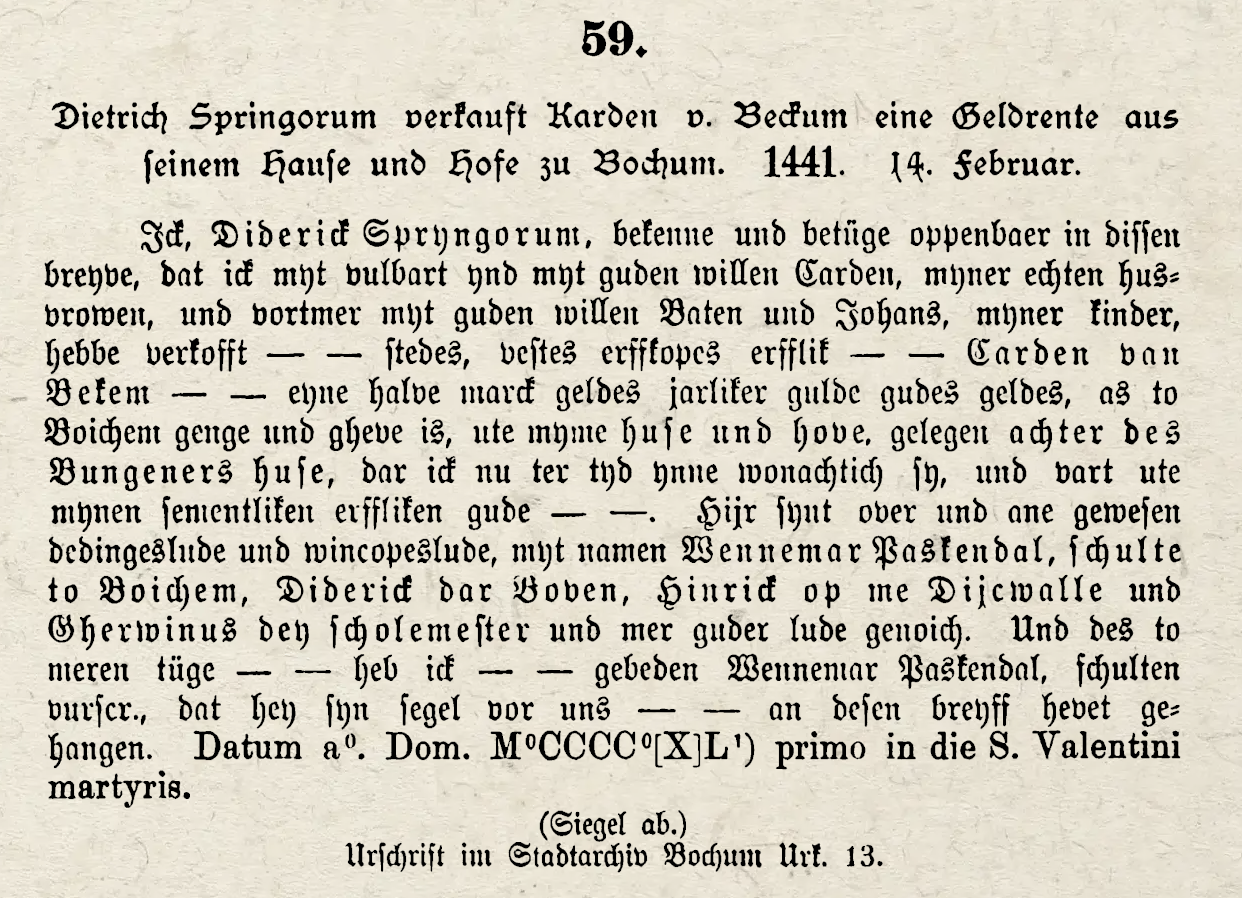
"I, Diederich Springorum, publicly declare and attest in this letter that I, with full knowledge and with the good will of Karden, my lawful wife, and further with the good will of Baten and Johann, my children, have sold - firmly, securely, and irrevocably - to Karden von Beckum one half-mark of money as an annual rent in good currency, as is customary and given in Bochum, from my house and farmstead situated behind the Bungener's house, where I currently reside, and from all my inherited property.
Present and participating as negotiating parties and witnesses were: Wennemar Paskendal, magistrate of Bochum: Diederich dar Boven; Hinrik op me Dijcwalle; and Gherwinus the schoolmaster, along with many other good people in sufficient number. And for further testimony, I have asked Wennemar Paskendal, the aforementioned magistrate, to affix his seal to this document on our behalf.
Dated in the year of our Lord 1441, on the first day [14 February] of St. Valentine the martyr. (Seal missing.)"
"Ick, Diderick Spryngorum, bekenne und betüge oppenbaer in dissen breyve, dat ick myt vulbart ynd myt guden willen Carden, myner echten husvrowen, und vortmer myt guden willen Baten und Johans, myner kinder, hebbe verkofft — stedes, vestes ersfkopes ersflik — Carden van Bekem eyne halve marck geldes jarliker gulde gudes geldes, as to Boichem genge und gheve is, ute myme huse und hove, gelegen achter des Bungeners huse, dar ick nu ter tyd ynne wonachtich sy, und vart ute mynen sementliken ersfliken gude.
Hijr synt over und ane gewesen dedingeslude und wincopeslude, myt namen Wennemar Paskendal, schulte to Boichem, Diderick dar Boven, Hinrik op me Dijcwalle und Gherwinus dey scholemester und mer guder lude genoich. Und des to meren tüge — heb ick gebeden Wennemar Paskendal, schulten vurscr., dat hey syn segel vor uns an desen breyff hevet gehangen.
Datum ao. Dom. M°CCCC°XLI primo in die S. Valentini martyris. (Siegel ab.)"
Source: https://www.google.nl/books/edition/Geschichte_der_Stadt_Bochum/ (p. 48) The original document can be found in: Stadtarchiv Bochum
1454 – Helping with a pledge sale
| Year | Event | Role |
|---|---|---|
| 1454 | Helping with a pledge sale | Administrator & Witness |
In this charter from 13 March 1454, Diederich Springorum did not act as a direct party in the inheritance dispute of Oefte, but as administrator and accounting witness. He supervised the sale of two horses pledged by Johan van Galen, accounted for the proceeds, costs, and payments, and declared the amount still outstanding. Since he had no seal of his own, he had the document sealed by Dietrich Conninge of Bochum.
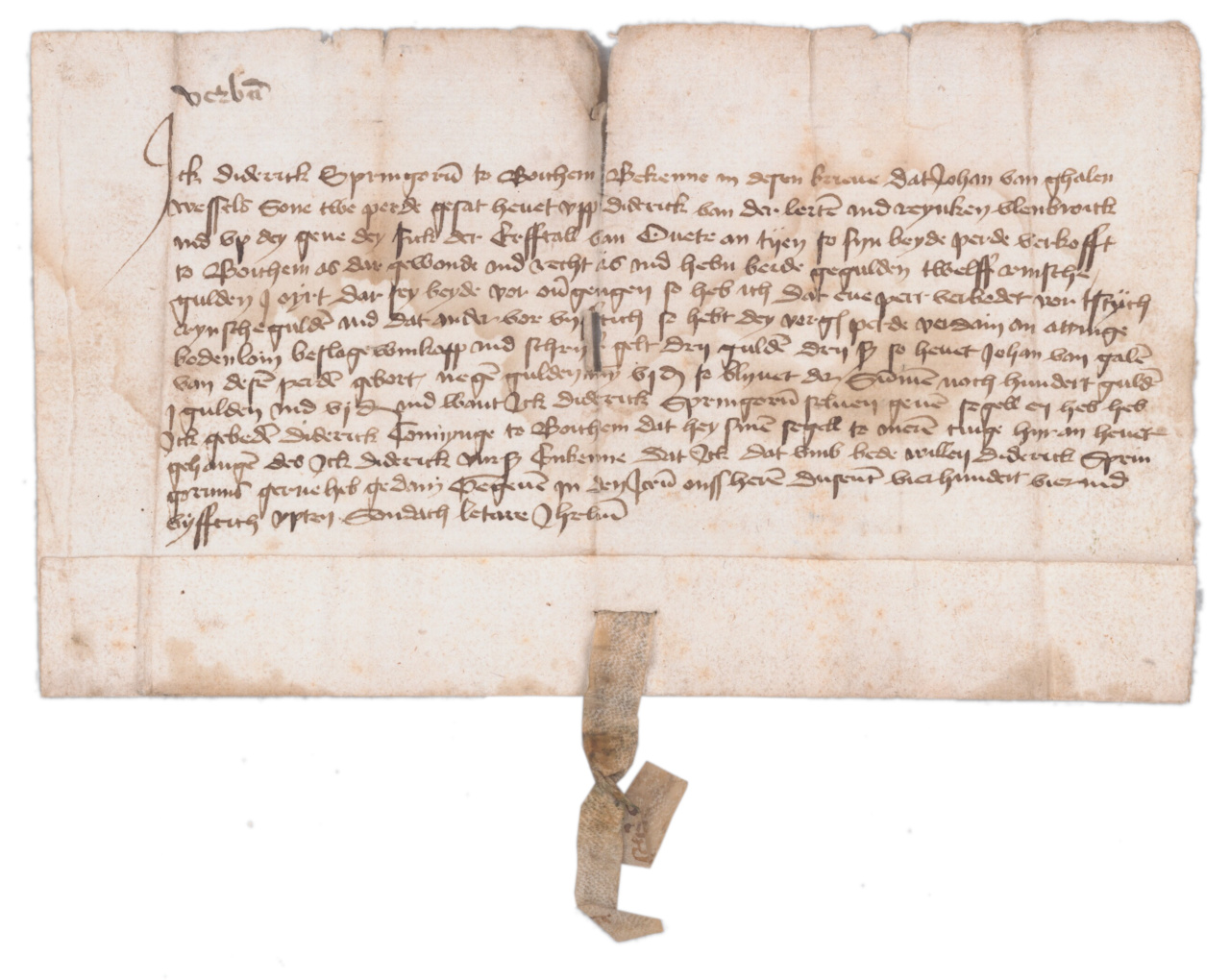
I, Diderick Springorum of Bochum, declare in this charter that Johan van Galen, son of Wessel, pledged two horses to Diderick van der Leithen, Reinken Ulenbroick, and others who assert claims to the inheritance at Oefte.
Both horses were sold in Bochum, as was customary and lawful there, together yielding twelve Rhenish guilders and one Ort (¼ guilder).
One horse was pledged for six Rhenish guilders, the other for five.
From the proceeds, three shillings were paid in charges (messenger’s fee, seizure fee, Winkauf, and writing fee).
Thus Johan van Galen received nine guilders minus six deniers. The outstanding principal remains one hundred guilders and four deniers.
Because I, Diderick Springorum, have no seal of my own, I asked Diderick Conninge of Bochum to affix his seal here as witness.
This I acknowledge to have done freely and willingly.
Given in the year of our Lord 1454, on Laetare Sunday.
Ick Diderick Springorum to Boichem bekenne in desen brieue, dat Johan van Ghalen, Wessels sone, twe perde gesat hevet upp Diderick van der Lerte ind Reynken Binenbroick ind up den gene, den felle der erfftall van Ouete an tijen.
So synt beyde perde verkofft to Boichem, as dar gewonede ind recht is, ind hebn beyde gegulden twelff ind eyn ort gulden, dair sey beyde vor overgengen.
So heb ich dat ene pert verbodet vor tstich seynsche gulden, ind dat ander vor vnstich, so hebt dey vorgenoemde perde verdain an attinge, bodenloyn, beslage, Winkauf ind schribgelt, dry schelling.
So hevet Johan van Gale van dese perde gebort negen gulden myns vi d., so blyvet der summe noch hundert gulden ind vier d.
Ind want ick, Diderick Springorum, selven geyn segel en heb, heb ick gebeden Diderick Comynge to Boichem, dat hey syne segill to mere tuige hyran hevet gehangen.
Des bekenne ick, Diderick voirs., dat ick dat umb beden willen dederick Springorum gerne heb gedan.
Gegeven in den jair uns heren dusent vierhundert vier ind vyfftich,up ten sondach Letare.
1456 – Loan secured on grain rent
Diderich Splythoff and his wife Telse pledge two Malter of grain rent—half rye and half barley, measured by the Bochum standard—from their farm in Bochum (Boichem), to Diderich Springorum, for twenty Rhenish gold guilders from the Oberland.
In this charter from 1456, Diderich Springorum acts as creditor. Diderich Splythoff and his wife Telse borrow twenty Rhenish gold guilders from him. As security for this loan, they pledge part of their grain rent: two Malter of grain (half rye, half barley) measured by the Bochum standard, from their farm in Bochum. Through this pledge, Springorum held collateral to secure repayment of his loan.
Unfortunately, no digital scans are available for this document.
1457 – Witness in a debt case
In 1457 Johan van Havekenscheide acknowledges before the court at Bochum (judges: the brothers Herman and Iserheyll Reneschen) that he owes Bitter Holinghe or the holder of this charter 9 Rhenish guilders. As security, he pledges an annual rent of 1 Malter of grain (half rye, half barley) measured by the Bochum standard, from his property at Gerte, called Schraegengut.
Seal witnesses: Herman and Iserheyll Reveschen, Diderich van Havekenscheide. Witnesses: Brech Hinrich Brechten, Frone, Johan Bicinchoff (Vitinchoff?), Johan Duker Neylinck, Diderich Springorum, Albert van Sunssbroike.
Role of Diderich Springorum: he was not a party to the agreement, but acted as a witness to the pledge.
Unfortunately, no digital scans are available for this document.