Johann Schriver genn. Springorum
City Secretary and Bürgermeister (mayor) of Bochum (1510)
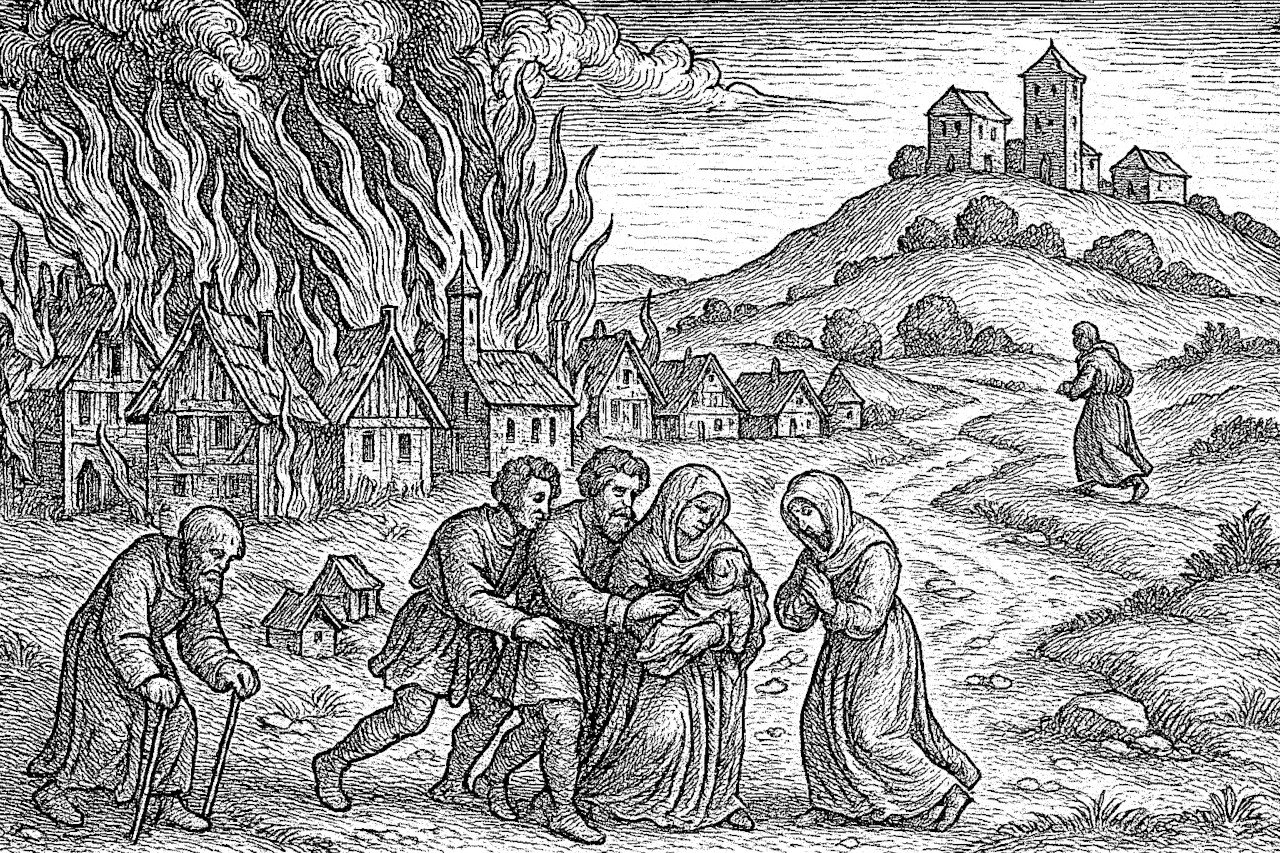
Johann Schriver gen. Springorum
Johann Schriver, later known by the byname Springorum, was born around 1470–1490, most likely in Bochum. He is probably a son or close descendant of Johann Springorum I (himself son of Diederich Springorum and Karden). Johann rose to prominence as a civic official: around 1500 he was town clerk (Schriver), and in 1510 he served as Mayor (Bürgermeister) of Bochum, together with Dirik Syben.
1517 - Town Fire of Bochum
His life took a dramatic turn with the great fire of 25 April 1517 (Mark’s Day). The blaze broke out in his own house. Although it was clearly an accident, the catastrophe destroyed large parts of Bochum, and the townspeople — in their anger and loss — blamed Johann and his family. They became scapegoats for the disaster. Their house was destroyed, their property seized, and Johann with his wife and children had to flee to Blankenstein.
1525 - Rehabilitation
After years of exile, a formal reconciliation was reached in 1525. The settlement was personally arranged and signed by Dirik Syben, the very man who had served as co-mayor with Johann back in 1510. By this agreement, Johann, his wife Anna von Eickel (widow of Detmar Berswordt), and their children were allowed to return to Bochum, rebuild their house, and reclaim their property. The city councils of Bochum and Hattingen pledged never again to hold them responsible for the fire. That it was Syben who mediated and sealed the settlement is striking: it shows how old civic partnerships could be revived, even after years of hostility.
Johann’s marriage to Anna von Eickel had already strengthened his position. In 1513, Anna renounced her rights to the estate of Rodensel, after which Abbot Anton of Werden enfeoffed Johann with this property. This step made the family both landholders and feudal vassals, and it marks the point where the occupational name Schriver (“scribe”) gave way to the hereditary family name Springorum.
Johann Schriver gen. Springorum thus stands at a turning point in the family’s history. His career shows the risks of civic prominence — how quickly status could turn to disgrace when disaster struck — but also the resilience and recovery possible through law, negotiation, and personal alliances.
1510 – Bürgermeister of Bochum
| Year | Event | Role |
|---|---|---|
| 1510-1517 | Bürgermeister of Bochum | Mayor |
Like his father (who was mayor from 1476 to 1482), Johann Schriver gen. Springorum became mayor of Bochum in 1510, together with Dirik Syben. The list does not indicate how long Johann served as mayor of Bochum, since no successors to Johann and Dirik are recorded; they are the last names mentioned.
Johann’s time in office as mayor, however, cannot have lasted more than seven years. In 1517 disaster struck when the great fire broke out in his house, forcing Johann and his family to flee to a neighboring town, Blankensteyn. From that moment he could no longer have served as mayor of Bochum.
1513 – Enfeoffment of Rodensel
| Year | Event | Role |
|---|---|---|
| 1513 | Enfeoffment of Rodensel | legal receiver and guarantor of the new arrangement |
After his marriage to Anna von Eickel, the widow of Detmar Berswort, Johann Schriver known as Springorum secured the estate of Rodensel in the parish of Bochum. The land had originally been granted to Anna as a marriage gift in her first marriage. To prevent future legal claims, Anna formally renounced her rights to the estate.
At her request, Abbot Anton enfeoffed Johann Springorum with Rodensel under service law. Johann swore loyalty to the abbey and held the estate as a fief, strengthening both his legal position and his standing within the local elite.
Laufzeit: 1513 Juli 21
Provenienz: Amtsgericht Essen
Allgemeine Formalbeschreibung: Überlieferungsart: Abschrift des 16. Jh.
Bemerkungen: Abschrift des 16. Jh. Akten Nr. 8 a 10 a, Bl. 181b
1525 – Settlement with Bochum & Hattingen
| Year | Event | Role |
|---|---|---|
| 1525 | Settlement with Bochum | Recipient |
Tensions with Schriver lingered until 7 April 1525, when the city council—among them mayor Dirik Syben, who had earlier served alongside him—together with mediators from Bochum and Hattingen, reached a settlement. Schriver, his wife, children, and heirs were allowed to return, rebuild their homestead, and reclaim their property as before the fire. The city pledged never again to hold them responsible, to protect them against future accusations, and to release them permanently from all claims. The charter was sealed by Bochum and co-sealed by Hattingen.
Formal agreement allows Johann, Anna von Eickel, their children and heirs to return, rebuild home, reclaim property; release from liability over the fire. Property restoration granted.
 |
 |
|---|
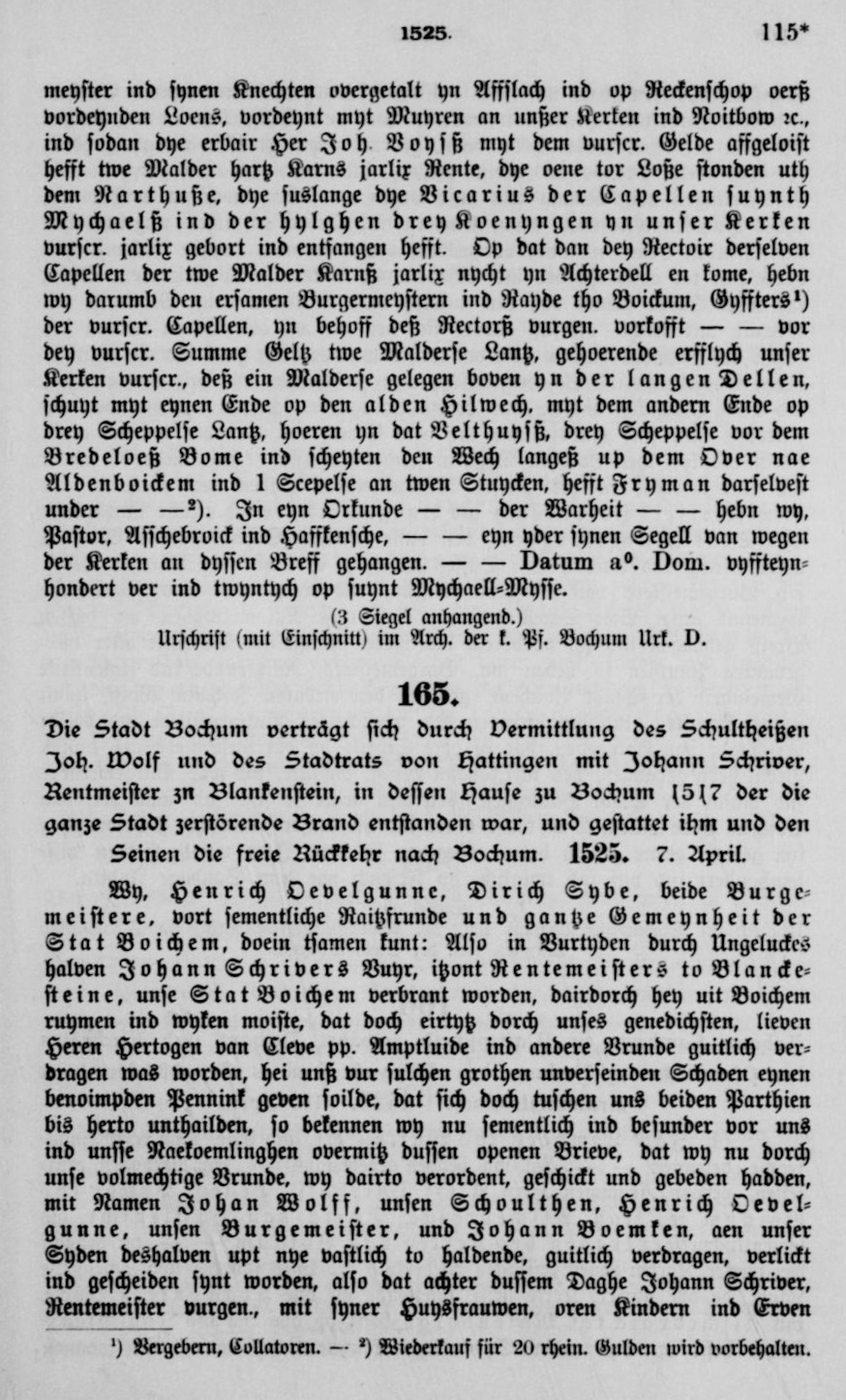
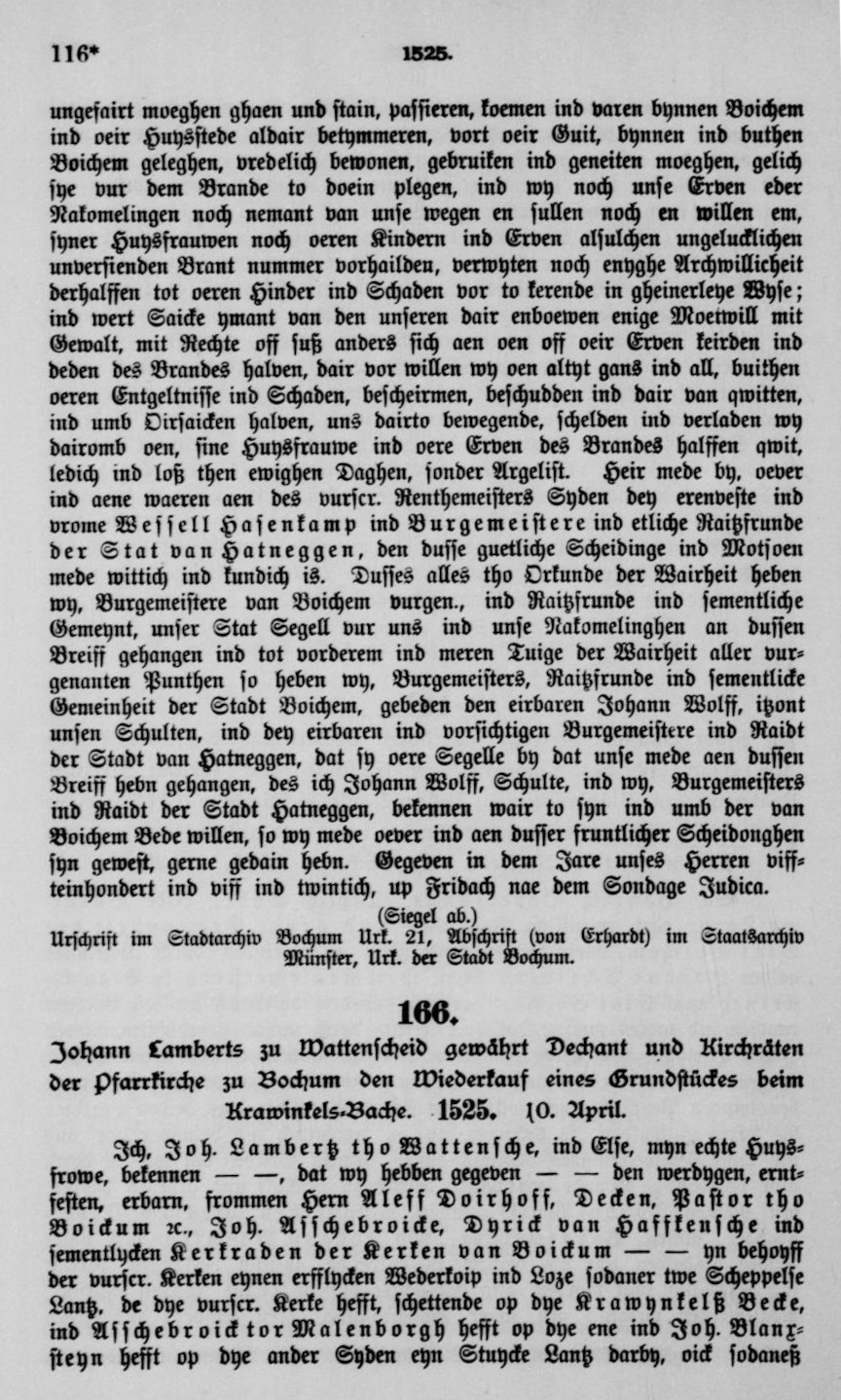
Image: Urkundenbuch B: Neuzeit, Nr. 165, 7 Apr 1525
We, Henrich Oevelgunne and Dirich Sybe, both mayors, on behalf of all the councillors and the whole community of the town of Bochum, make known the following: Since, in past times, by accident, the house of Johann Schriver, now rentmaster at Blankenstein, gave rise to the fire by which our town of Bochum was burned, and since for that reason he had to leave and withdraw from Bochum—although earlier, through the good offices of the officials of our most gracious lord, the Duke of Cleves, and other friends, an amicable settlement had been made, namely that he should give us, for such great and unforeseen damage, a specified payment—yet this remained unsettled between the parties until now.
We therefore acknowledge, jointly and severally, for ourselves and our descendants, by this open letter, that we have now, through our fully empowered representatives appointed, dispatched, and asked for this purpose—namely Johann Wolff, our Schultheiß, Henrich Oevelgunne, our mayor, and Johann Doemken—come to an amicable agreement, reconciliation, and settlement, to be firmly upheld from now on; that is, from this day forward Johann Schriver, rentmaster, together with his wife, their children and heirs, may safely go and stand, pass, come and travel within Bochum, and may rebuild their homestead there; furthermore, they may peacefully dwell in, use, and enjoy their property located within and outside Bochum, just as they were accustomed to do before the fire.
And we, nor our heirs or successors, nor anyone on our behalf, shall ever hold against him, his wife, or their children and heirs that unfortunate and unforeseen fire, nor reproach or accuse them for it so as to turn it to their hindrance or harm in any way. And should anyone among our people nevertheless, with force, by law, or otherwise, proceed against him or his heirs on account of the fire, we will at all times protect, defend, and acquit him fully from it, without cost or damage to him.
For this reason, which moves us, we remit and release him, his wife, and their heirs, fully and forever, from all matters pertaining to the fire—free and clear, without deceit.
Furthermore, on the side of the aforesaid rentmaster, the honorable and prudent Wessell Hasenkamp, and the mayors and several councillors of the town of Hattingen, are likewise aware of this amicable settlement and arbitration.
In witness of all this, we, the mayors of Bochum, the councillors, and the whole community, have affixed the town seal to this letter on our own behalf and that of our descendants; and, as further and greater testimony of the truth of all the foregoing points, we have asked the honorable Johann Wolff, our Schultheiß, and the honorable and prudent mayors and council of the town of Hattingen to attach their seals together with ours to this letter—which I, Johann Wolff, Schultheiß, and we, the mayors and council of the town of Hattingen, attest to be true; and because we too have been present and party to this friendly settlement, we have gladly done so.
Given in the year of our Lord fifteen hundred and five-and-twenty, on Friday after Judica Sunday. (Seals.)
Die Stadt Bochum verträgt sich durch Vermittlung des Schultheißen
Joh. Wolf und des Stadtrats von Hattingen mit Johann Schriver,
Rentmeister zu Blankenstein, in dessen Hause zu Bochum 1517 der die
ganze Stadt zerstörende Brand entstanden war, und gestattet ihm und den
Seinen die freie Rückkehr nach Bochum. 1525. 7. April.
Wy, Henrich Oevelgunne, Dirich Sybe, beide Burgemeistere, vort sementliche Raißfrunde und gantze Gemeynheit der Stat Boichem, doen tamen kunt: Also in Burytden durch Ungeluces halven Johann Schribrs Buyr, ixont Rentemeisters to Blandesteine, unse Stat Boichem verbrant worden, dairdorch hey nit Boichem ruhmen ind wyken moiste, dat doch eirtyt dorch unses genedichsten, lieven Heren Hertogen van Cleve pp. Amptluide ind andere Brunde guitlich verdragen was worden, hei unß bur sulchen grothen unverseinden Schaden eynen benoimpden Pennink geven soilde, dat sich doch tuschen uns beiden Parthien bis herto unthailden, so bekennen wy nu sementlich ind besunder vor uns ind unsse Naekoemlinghen overmitz dussen openen Brieve, dat wy nu dorch unse volmechtige Brunde, wy dairto verordent, geschickt und gebeden habden, mit Namen Johan Wolff, unsen Schoulthen, Henrich Oevelgunne, unsen Burgemeister, und Johann Doemken, aen unser Syden deshalven upt nye bastlich to haldende, guitlich verdragen, verlickt ind gescheiden synt worden, also dat achter dussem Daghe Johann Schriver, Rentemeister burgen, mit syner Huhsfrauwen, oren Kindern ind Erben ungefairt moeghen ghaen und stain, passieren, koemen ind varen bynnen Boichem ind oeir Huysfiede aldair betymmeren, vort oeir Quit, bynnen ins buthen Boichem geleghen, vredelich bewonen, gebruiten ind geneiten moeghen, gelich sye vur dem Brande to doein plegen, ind wy noch unse Erben eder Natomelingen noch nemant van unse wegen en fullen noch en willen em, syner Huysfrauwen noch deren Kindern ins Erben alsulchen ungelüclichen unversienden Brant nummer vorhailden, verwyten noch entahe Archwillicheit derhalffen tot deren Hinder ind Schaden vor to kerende in gheinerleye Wyse; ind wert Saice ymant van den unseren dair enboewen enige Moetwill mit Gewalt, mit Rechte off suß anders sich aen oen off oeir Erben keirden ind deden des Brandes halven, dair vor willen wy oen altyt gans ind all, buithen deren Entgeltnisse ind Schaden, bescheirmen, beschubden ind dair van gwitten, ind umb Dirsaicen halven, uns dairto bewegende, schelden ind verladen wy dairomb oen, sine Huhsfrauwe ind dere Erben des Brandes halffen gwit, ledich ind loß then ewighen Daghen, sonder Argelist.
Heir mede by, oeber ind aene waeren aen des burscr. Renthemeisters Syden dey erenbeste ind prome Wessell Hasenkamp ind Burgemeistere ind etliche Raißfrunde der Stat van Hatneggen, den dusse guetliche Scheidinge ind Motjoen mede wittich ind kundich is.
Dusses alles tho Orkunde der Wairheit heben wy, Burgemeistere van Boichem burgen., ind Raitzfrunde ind sementliche Gemeynt, unser Stat Segell vur uns ind unse Nakomelinghen an dussen Breiff gehangen ind tot vorderem ind meren Tuige der Wairheit aller vurg enanten Punthen so heben wy, Burgemeisters, Raibfrunde ind sementlicke Gemeinheit der Stadt Boichem, gebeden den eirbaren Johann Wolff, ipont unsen Schulten, ind dey eirbaren ind vorsichtigen Burgemeistere ind Raidt der Stadt van Hatneggen, dat sy dere Segelle by dat unse mede aen dussen Breif hebn gehangen, des ich Johann Wolf, Schulte, ind wy, Burgemeisters ind Raidt der Stadt Hatneggen, bekennen wair to syn ind umb der van Boichem Bede willen, so wy mede oeber ind aen dusser fruntlicher Scheidonghen syn gewest, gerne gedain hebn. Gegeven in dem Jare unses Herren biffteinhondert ind biff ind twintich, up Fridach nae dem Sondage Judica.
(Siegel ab.)
Urschrift im Stadtarchiv Bochum Urk. 21, Abschrift (von Erhardt) im Staatsarchiv Münster, Urt. der Stadt Bochum.