The Early Springorums
Bochum Origins and the Road to Dortmund.
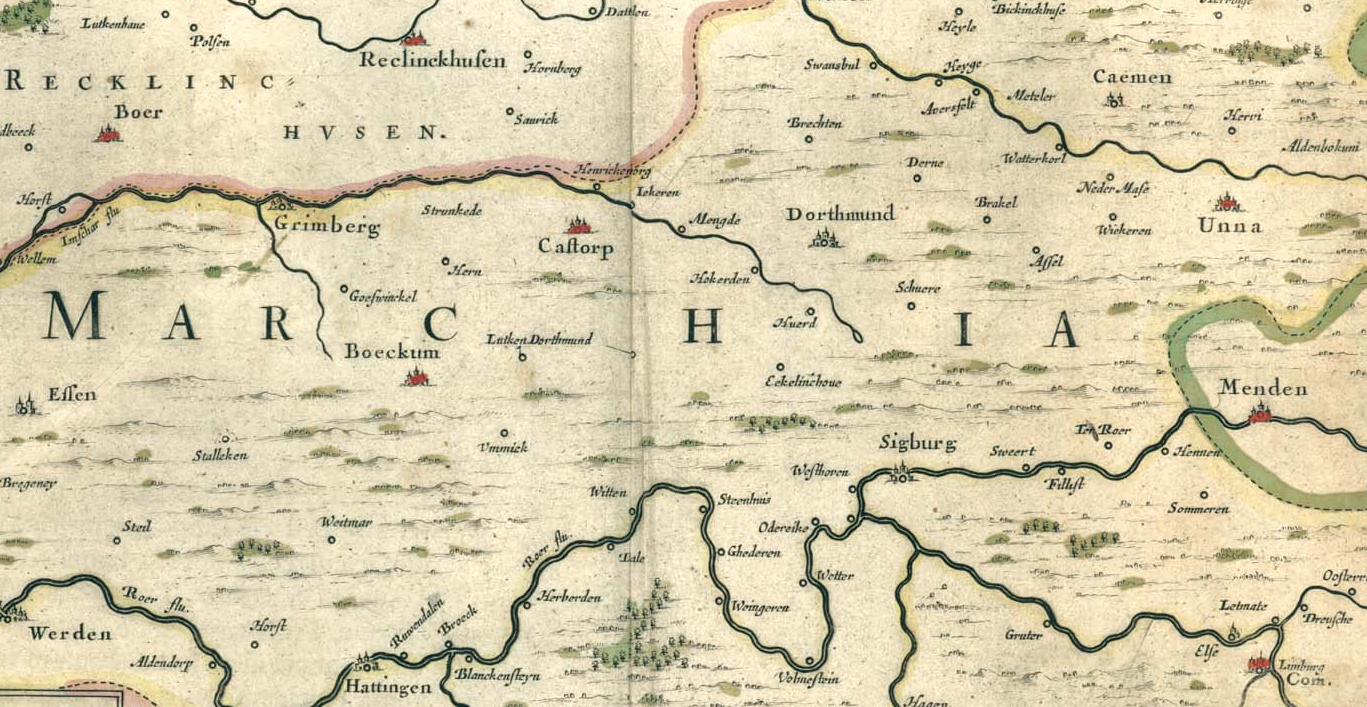
Image: Detail from the map “Comitatus Marchia et Ravensberg” (Counties of Mark and Ravensberg), published in 1645 in the Atlas Maior by Willem and Joan Blaeu. This part of the map covers all the places where the early Springorums were found: Bochum (Boeckum), Dortmund, Heinrichenburg, Wetter and Unna.
Source: https://de.wikipedia.org/wiki/Historische_Karten_der_Stadt_Bochum
Bochum in the 15th century
During my research, I’ve come across many documents mentioning the name Springorum, but I haven’t yet been able to connect them all with the established family tree. On these pages, I’ve gathered all Springorums who appear in the 15th and 16th centuries—before the time of Reinhard Springorum—in the area around Bochum.
I cannot prove that they were all related, though some are undoubtedly family members, as the charters suggest. And if I allow myself a bit of imagination, I can begin to picture what a pedigree of these early Springorums might actually look like.
Brief historical overview: Bochum 1400-1600
Around 1400, Bochum was a modest town in the County of Mark, set along the Westphalian Hellweg—the main east–west artery through Westphalia. It functioned more as a local court seat (Gogericht) and market town than as a major trading hub. The first mayors appear in the record in 1407, and in 1438 a knight endowed the Rodden-Gut in Gerthe to fund a charitable guesthouse (Gasthaus) and hospital for the poor—evidence of emerging civic institutions and organized social care.
Town Fire 1517
The defining catastrophe was the great city fire of Mark’s Day, 25 April 1517. Starting in the house of a townsman named Johann Schrivers genn. Springorum, flames raced through dense timbered streets and thatched roofs, destroying virtually the whole town, including the old parish church. Rebuilding took years: the church (today’s Propsteikirche St. Peter und Paul) received its net vaulting in 1536 and a completed tower by 1547; municipal reconstruction stretched across the decade. During the fire, Bochum’s main parish church was destroyed by fire also. To finance the construction of a new church, a tax was levied. From the so-called “Kirchensteuer” list of 1525, we know that the town of Bochum at that time consisted of roughly one hundred houses and 157 inhabitants. Two hundred years later, in 1722, the town had grown to 350 houses, 135 of which were still roofed with thatch.
Epidemics
Epidemics repeatedly stalled recovery. Besides an outbreak of the “English sweat” in 1529, Bochum faced several plague waves in the 16th century—documented for 1542, 1544 (so severe that residents reportedly fled into nearby woods), 1583, and 1589. These shocks, together with a further major fire in 1581, kept population and prosperity fragile.
Politically, Bochum sat inside the County of Mark, which from 1521 belonged to the United Duchies of Jülich-Cleves-Berg—a sprawling personal union that shaped administration, taxation, and confessional policy in the region. That broader framework—and Bochum’s position along the Hellweg line (through nearby Wattenscheid and Bochum itself)—set the stage for the town’s slow, resilient rebuild at the close of the 1500s.
Politics, War and Religion
In the 15th and 16th centuries, Bochum was part of the County of Mark and had to follow the politics of its rulers. The town itself saw little fighting, but people still felt the effects of wars and rising taxes. After 1520, the Reformation brought new Protestant ideas that spread through the region and clashed with the old Catholic traditions. Parish life and church appointments often became a point of conflict. During the Schmalkaldic War (1546–1547), the struggle between Protestants and Catholics touched Bochum as well, adding to the uncertainty already caused by fire, plague, and poverty.
The Early Springorums: A Tentative Pedigree
Generation -8 (unknown)
No identifiable individuals can be assigned to this generation. Earlier ancestors of the Springorum family are not documented in surviving sources.
Generation -7 (earliest documented name bearers)
The Springorum name first appears in early-15th-century Bochum. Two figures belong to this generation: Celce (Celse) Springorum, recorded in 1423, and Diederich Springorum, documented in 1441 with his wife Karden and their children Baten and Johann (der Ältere). Although a familial connection between Celce and Diederich is possible, it is not explicitly attested, and they are therefore treated as parallel members of the same generation.
Generation -6 (proven)
Johann Springorum (der Ältere), son of Diederich and Karden, is securely documented and represents the continuation of the Bochum Springorum household into the later 15th century.
Generation -5 (proven)
This generation consists of Johann Schriver and Nese Springorum, who are securely identified as the parents of the next generation. Their placement fixes the later Schriver genannt Springorum line one step forward.
Generation -4 (proven)
Johann Schriver genannt Springorum, son of Johann Schriver and Nese Springorum, marks the point at which Springorum functions as a stable hereditary identifier in Bochum records. He stands at the transition between late-medieval naming practice and early-modern family continuity.
Generation -3 (proven parents)
The parents of the mid-16th-century sibling group are [Unknown] Springorum and Margarete von den Hembecke. While little is known about their individual lives, their position is secure through the clear documentation of their children.
Generation -2 (proven sibling group; includes Agnes)
This generation comprises the siblings Agnes Springorum (1542-1568), Johann, Gerrit, Sibert, Anna, and Diederich Springorum. Agnes and Gerrit are especially well documented: on 14 January 1568 they signed a mutual inheritance contract prior to traveling abroad. Later that same year, during the plague, Agnes made her will in Cologne and established a charitable foundation in Bochum, intended to provide dowries for poor brides. The documentation of this sibling group reflects both wealth and civic standing.
Generation -1 (proven)
Johann Springorum (II), son of Johann Springorum (-3), represents the culmination of the pre-modern Bochum line in this table. Active in the mid- to late-16th century, he served the city for decades as court clerk, deputy judge, feudal tenant, and ultimately city secretary, placing the Springorum family firmly within Bochum's administrative elite.
Generation 0
Reinhard Springorum (1593-1666) belongs to generation 0 and marks the beginning of the Dortmund branch
| Gen | Person | Inferred birth | Sources | Notes / Connection / Rationale |
|---|---|---|---|---|
| -7 | c. 1395–1410 | Adult in 1423 difficult-to-read Bochum charter | Possibly a brother of Diederich. Name/reading uncertain (paleography). Chronology fits a generation earlier. Hypothetical ancestor. | |
| -7 |
Diederich Springorum |
c. 1395–1410 | Adulkt with sons in 1441 charter (sale of rent to Karden von Beckum); charters 1454–1457 |
First securely documented Springorum; landowner in Bochum. Proven family founder, father of Baten and Johann in sources. |
| -6 | c. 1415–1425 | Son of Diederich in 1441 charter; Bürgermeister 1476 |
Explicitly named as child of Diederich in 1441. Most plausible father (or grandfather) of Johann Schriver genn. Springorum on chronological grounds. In 1476 war er Bürgermeister zu Bochum. |
|
| -5 |
Nese (Agnes) Springorum |
c. 1445–1455 | ... | Daughter of Johann Springorum (der Ältere). |
| -5 |
Johann Schriver |
c. 1440–1450 | ... | Richter zu Essen. |
| -4 |
Johann Schriver gen. Springorum |
c. 1475–1485 | Explicitely documented Werden charter 1513 (Rodensel) | Citizen of Bochum; husband of Anna von Eickel. Transition from byname Schriver to hereditary surname Springorum. Likely grandson of Diederich via Johann (der Ältere). |
| -2 |
Johann (II) Springorum |
c. 1535–1540 | Adult by 1565; Stadsekretär; Norderhof (1565); Leimsiepen (1586, 1597); multiple legal acts |
Stated 1565 as “son of the late Johann Schriver”. Career from clerk → deputy judge → city secretary → procurator. Proven son of Johann Schriver. |
| -1 | c. 1545–1550 | Heimatbuch Bochum 4. 1925 | Son of Johann Springorum II, hypothetical father of Reinhard. If born ca. 1560–1570, would be 20–30 at Reinhard’s birth (1593). Explains chronology more naturally. | |
| 0 |
Reinhard Springorum |
1593–1666 | Dortmund city & church records | Founder of the Dortmund branch. Ages align for Johann (II) to be his grandfather; migration Bochum→Dortmund is plausible. No explicit parentage record. Most likely grandson of Johann (II). |
-7: Celse & Diederich
Celse (Celseke) Springorum and Diederich Springorum belong to the same generation and should not be understood as a father-son pair. Celse is already documented as an economically independent adult in 1423, which places his birth around the late fourteenth century, while Diederich appears somewhat later in the sources, from the mid-fifteenth century onward, as the husband of Karden and the father of Johann and Baten. The chronological overlap and the absence of explicit filiation formulas in the records make a direct father-son relationship implausible; instead, the evidence strongly suggests that Celse and Diederich were brothers, or at least very close relatives within the same generational cohort of the Springorum family.
Celse Springorum c. 1385–1400
In 1423, Celse Springorum purchased a hereditary estate near the bridge in Bochum, at the site of the bishop’s house. The deed, sealed before the city court, marks the earliest known appearance of the family in official records. Since Celse must have been of legal age to conclude such a transaction—probably between 25 and 40—his birth can be placed around 1385–1398, making him a contemporary of Diederich Springorum and the likely founder of the documented line.
Diederich Springorum c. 1385–1400
In the 15th century, Diederich Springorum of Bochum emerges in a series of charters that portray him as a respected and established townsman. The earliest surviving record, from 1441, shows him and his wife Karden—with the consent of their sons Baten and Johann—selling an annual rent of half a mark from their house and farmstead in Bochum to Karden von Beckum. The deed was confirmed before the town magistrate and other prominent citizens. Between 1450 and 1460, Diederich’s name appears repeatedly in documents, variously as witness, administrator, and creditor. Since he already had an adult son in 1441, and given his active civic role in the 1450s, his birth can be estimated to fall between 1385 and 1400.
-6: Johann and Baten
Johann Springorum (der Ältere) c. 1415–1425
Johann Springorum (der Ältere), explicitly identified in the sources as a son of Diederich Springorum, is among the earliest known bearers of the family name in Bochum. In 1441 he appears as Diederich’s child, giving his consent to a deed of his father. Later, in 1476, Johann is recorded as mayor of Bochum. These references suggest a birth between 1415 and 1425—old enough (15–25) to confirm his father’s deed, and in his late forties to mid-fifties (46–56) when he assumed the mayoralty.
On chronological grounds, he is the plausible father of Nese Springorum who married Johann Schriver, the first to combine the Schriver name with the Springorum byname. While a direct genealogical proof is lacking, the timing and social position make it highly likely that he was indeed the father of Nese Springorum, thereby bridging the earliest mentions of the family with the later documented line.
-5: Johann Schriver, Nese Springorum
-4: Johann Schriver genannt Springorum, Anna von Eickel
Johann Schriver genn. Springorum c. 1470–1490
Johann Schriver gen. Springorum is one of the first clearly identifiable bearer of the Springorum name in the Bochum archives of the early 16th century. In a charter dated 1513, he is mentioned as a citizen of Bochum and husband of Anna von Eickel, widow of Detmar Berswordt. The document shows that Anna renounced her rights to the estate of Rodensel, after which Abbot Anton of Werden enfeoffed Johann Springorum with it under vassalage law. This record marks the transition from a descriptive byname (Schriver, “clerk” or “scribe”) to the hereditary family name Springorum, which his descendants would continue to use in the following generations.
-3: Johann Springorum, Margarethe vond den Hembeck
Johann Springorum (II) c. 1525–1540
Johann Springorum (II), son of Johann Schriver gen. Springorum, appears frequently in the Bochum archives between 1565 and 1602. His career reflects a steady rise in local society: first mentioned as the enfeoffed heir of the Norderhof estate in Hunthamme, he later served as gerichtsschreiber (court clerk), unterrichter (deputy judge), and ultimately as city secretary of Bochum. The charters also show him acting as feudal tenant, witness in important transactions, and even procurator in a legal case for the von Viermundt family.
-2: Johann, Agnes, Gerrit, Sibert, Diederich & Anna Springorum
Sibertus Springorum c. 1560–1580
Sibertus Springorum (died 1636) was the son of Johann Springorum and Maria Beckmann. Like his father, he worked for the city of Bochum as a court clerk. He was officially appointed to this job in 1631 and kept it until his death in 1636. With him, the role of clerk left the Springorum family and passed to other officials.
Early Springorums not yet connected
The early Springorums—names that appear in 15th- and early 16th-century records of Bochum, Querenburg, and Frielinghausen—cannot yet be connected with certainty to the later, well-documented family line that begins with Johann Springorum (city court clerk from 1569). Mentions such as Anton Springorum in the Bürgerbuch of 1536, or the “Sprynghorums Gut” noted in 1547, show the name in use, but the exact family ties remain unclear. These references demonstrate that the name already carried weight in the region, even if the genealogical link to the 17th-century Springorums has not yet been proven.
Early Mentions of the Springorum Name (unconnected lineages)
-
1478 – One of the earliest known Springorum seals: Johann Springorum as witness to a deed of knight von Galen at Rechen, near Bochum (Staatsarchiv Münster, Rittergut Rechen Urkunde).
-
1486 – Schatzbuch der Grafschaft Mark: mentions several Frielinghausen farms, later including “Springorums Gut” (though at this date without clear owner).
-
1536 – Bochumer Bürgerbuch: Anton Springorum named among the “old men” (Sander Steinberg, Peter von Soest, etc.) during a boundary inspection at the Vöde near Ladbecke.
-
1547 – Kirchenschatzungsregister (Darpe S. 213): one of the Frielinghausen farms listed as “Sprynghorums Gut, ys gepant” (pledged property).
-
1591 – Deed of sale (Darpe, Urkundenbuch): voogden of Margarete Berswordt sell part of the Breloh woodland to Gerhard and Katharina Springorum in Altenbochum.